Choosing between a Telegram group and a Telegram channel becomes difficult when the format starts shaping daily work: who publishes, who moderates, how users ask questions, how ads are measured, and where important updates stay visible.
The wrong format creates practical problems. A media brand that starts with a group may lose important posts inside daily chat. A SaaS company that uses only a channel may miss support questions and product feedback. A course creator that relies only on discussion may struggle to keep official lessons and announcements easy to find.
This guide compares both formats by purpose, reach, engagement, moderation, analytics, advertising value, and common business use cases.
Quick Answer
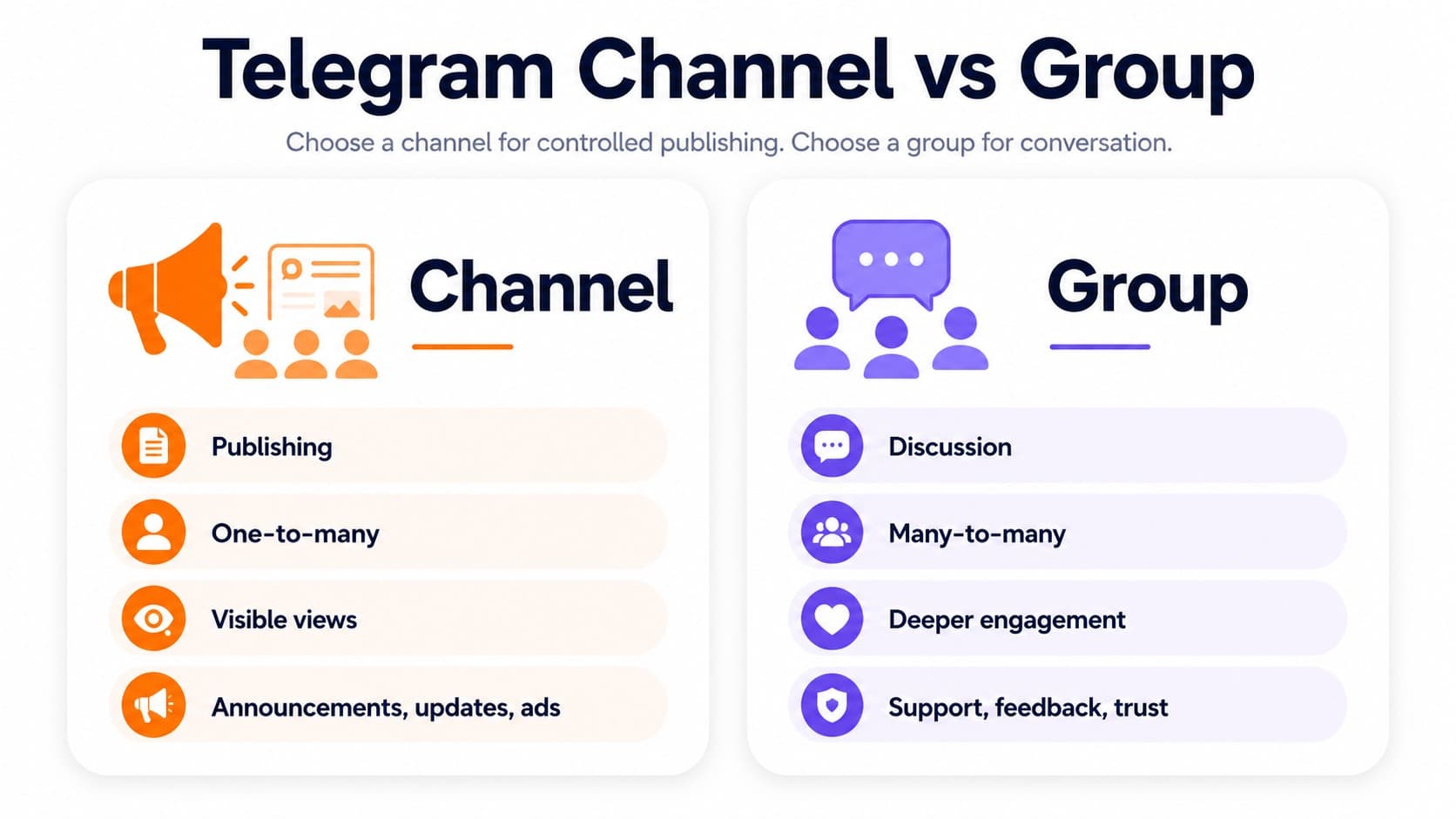
Use a Telegram channel when you need a controlled publishing space: news, updates, product announcements, expert content, media distribution, paid content, or a brand-owned audience.
Use a Telegram group when you need member participation: customer support, discussion, feedback, peer learning, local communities, beta testing, or trust-building around a complex offer.
Use both when the channel should attract and educate people, while the group should answer questions, build trust, and keep the community active. This is often the strongest setup for brands, creators, education projects, Web3 communities, SaaS products, and advertisers.
Telegram Channel vs Group - The Core Difference
A Telegram channel is a one-to-many publishing tool. Admins post, subscribers read, react, forward, and sometimes comment if comments are enabled through a linked discussion group. Each channel post has a view counter, and channels can support unlimited subscribers.
A Telegram group is a many-to-many communication space. Members can post, reply, mention each other, share files, vote in polls, and participate in ongoing discussions. Telegram groups can support up to 200,000 members and include moderation tools, permissions, pinned messages, anti-spam tools, bots, and Topics.
That difference changes everything: content planning, moderation, analytics, advertising, user behavior, and monetization.
| Criterion | Telegram Channel | Telegram Group | What It Means in Practice |
|---|---|---|---|
| Main purpose | Publishing content to an audience | Hosting conversation among members | Use a channel when the message needs to stay clear and organized. Use a group when discussion creates value. |
| Communication model | Mostly one-to-many | Many-to-many | A channel protects message control. A group creates interaction, but also adds noise and moderation work. |
| Who can post | Admins and selected roles | Members, depending on permissions | Channels are easier to manage. Groups need clear rules, admin roles, and spam control. |
| Measurement | Views, reactions, forwards, shares, and channel stats for eligible channels | Active members, replies, recurring topics, moderation events, and business outcomes | Channels are easier to compare for content and advertising. Groups need community-quality metrics. |
| Best marketing use | Announcements, expert content, paid placements, product updates, funnel entry | Support, feedback, onboarding, peer proof, trust-building | Channels are better for reach and distribution. Groups are better when people need to ask questions or learn from others. |
| Main risk | Passive audience, low discussion, weak retention | Spam, off-topic posts, moderation overload, repeated questions | The operating model should match the format: publishing discipline for channels, community management for groups. |
What Is a Telegram Channel?
A Telegram channel is a publishing feed. It works well when the owner needs to speak clearly to a large audience without every post turning into a public chat.
Channels are used by:
- media publishers that post news, analysis, and explainers;
- brands that share updates, launches, offers, and product education;
- creators who publish premium insights, lessons, or curated content;
- advertisers who need measurable post views and predictable placement logic;
- community owners who want one official feed separate from informal discussion.
Telegram channels support comments through a linked discussion group. When enabled, subscribers see a comment button under posts, and comments appear both in post threads and in the connected group. This lets a channel stay clean while still allowing feedback.
Channels also support reactions, pinned posts, scheduled posts, admin roles, post links, and statistics for eligible channels.
When a Channel Works Best
A channel is usually the better first choice when your main asset is content. If you publish analysis, product updates, market news, educational posts, deal alerts, or expert commentary, you need a format where the message stays visible and organized.
A channel is also easier to use for advertising. Every post has a visible view count, which helps estimate CPM, compare placements, and judge whether an audience is active. For advertisers, this matters more than subscriber count alone.
A channel is a strong fit for these cases:
- Brand publishing - a company shares product updates, guides, case studies, discount announcements, or event reminders.
- Media and newsletters - a publisher distributes short news posts, curated links, market updates, or opinion pieces.
- Creator monetization - a creator runs a free public channel and sends the most engaged readers to a paid private channel.
- Ad placements - an advertiser buys a native sponsored post and tracks clicks, joins, leads, or sales through one clear link.
- Official updates - a project needs one reliable source of truth, especially when rumors or user discussions happen elsewhere.
For more detail on channel growth, see: Practical Guide to Growing a Telegram Channel.
What Is a Telegram Group?
A Telegram group is a shared conversation space. It works when people need to talk to each other, not only listen to the owner.
Groups are used for:
- support communities;
- course cohorts;
- local chats;
- product beta groups;
- professional communities;
- investment, crypto, gaming, SaaS, and hobby discussions;
- private customer or member spaces.
Groups can be simple, but large groups need structure. Telegram supports replies, mentions, hashtags, pinned messages, admin privileges, default member permissions, anti-spam tools, bots, and Topics.
Topics are especially important for larger communities because they split discussion into separate spaces. A busy SaaS community, for example, might use Topics for product questions, feature requests, bugs, integrations, announcements, and off-topic chat. Telegram also expanded topic navigation with topic tabs, making large groups easier to use.
When a Group Works Best
A group is the better choice when the value comes from interaction. If users need to ask questions, compare experiences, get support, or talk to peers, a channel alone may feel too distant.
A group is especially useful when the product or topic requires trust. People often want to see how others discuss a course, trading community, SaaS tool, coaching program, or local service before they commit.
A group is a strong fit for these cases:
- Customer support: users ask questions, other users help, and admins can answer publicly once instead of repeating the same answer in private messages.
- Education: students discuss assignments, share progress, ask questions, and learn from each other.
- Beta testing: early users report bugs, suggest features, and give fast product feedback.
- Local communities: members exchange recommendations, events, job leads, and real-time updates.
- High-consideration offers: people can ask questions before buying, which helps reduce doubt and friction.
Groups are not "free engagement." They are an operating commitment. If nobody moderates, summarizes, and guides the conversation, the group can become a noisy inbox instead of a community asset.
Sara Al MansooriAdTech Strategist at MangoAds.
Key Differences That Matter in Real Campaigns
1. Reach and Scalability
In real campaigns, scale means different things. For a channel, scale is reach and repeatable post views. For a group, scale is the ability to keep discussion useful as more members join.
For marketers, the practical question is not "Which format is bigger?" It is "Where will the message keep its value?" A product update, market note, or sponsored post usually works better in a channel. A discussion, support thread, or community recommendation usually works better in a group.
2. Engagement Quality
Channel engagement is usually lighter but easier to measure: views, reactions, forwards, comments, and link clicks. It shows whether people are consuming and sharing the content.
Group engagement is deeper but harder to standardize. Members ask questions, compare experiences, mention problems, recommend tools, and respond to each other. This makes groups useful for understanding objections, product language, support needs, and buyer intent.
For a marketer, both signals matter. A channel shows reach. A group shows what people actually care about.
3. Moderation Load
A channel is easier to operate because admins control the main feed. Even if comments are enabled, the official content remains organized.
A group needs more active management. Without rules and moderation, it can quickly turn into spam, repeated questions, off-topic debates, or low-quality promotion.
A basic group setup should include a pinned rules post, limits on links or media from new members, clear admin roles, Topics for larger communities, and regular summaries so useful information does not disappear inside the chat.
4. Analytics and Measurement
Channels are easier to measure for content and advertising because posts have visible view counters. Eligible channels also have statistics for growth, reach, and post performance. This makes channels more convenient for media buying, CPM estimates, and paid placement analysis.
Groups require different metrics. Member count is not enough. A group should be evaluated by active members, quality of questions, admin response time, spam rate, recurring topics, and whether discussions lead to business outcomes such as leads, trials, purchases, support deflection, or product feedback.
For a comparison of analytics tools for channels, groups, public research, and community management, see: Best Telegram Analytics Tools in 2026
5. Privacy and Trust
Channels feel more private for subscribers because the subscriber list is not visible to other readers. This can matter in sensitive niches such as finance, health, career change, or personal development.
Groups are more social. Members can see discussions, recognize active participants, and build trust through peer interaction. That same openness can also create risk if the topic is sensitive or the group is poorly moderated.
Use a channel when people mainly need to read. Use a group when seeing and joining the conversation adds value.
6. Discoverability
Public channels can benefit from usernames, public links, search, similar channel recommendations, public post search, forwards, and external indexing of public t.me pages. These discovery surfaces can help, but they should not be treated as guaranteed traffic sources.
Groups can also be public and discoverable, but visibility alone is not enough. A visible group full of spam or low-quality discussion will not build trust. For groups, discoverability only helps when the community looks active, relevant, and safe to join.
When to Use a Channel Only
A channel-only setup works when conversation is not the main product. This is common for publishers, brands, expert creators, deal feeds, newsrooms, ecommerce promotions, and official company updates.
Example 1: B2B SaaS Product Updates
A SaaS company launches a Telegram channel for release notes, integration tips, webinar reminders, and short product education posts. The goal is not to answer every support question in Telegram. The goal is to keep users informed and drive them to docs, demos, and feature pages.
A group would create more work than value at this stage.
Example 2: Ecommerce Deal Feed
A retailer posts daily offers, flash sales, and coupon codes. The channel format works because users want quick updates, not a long conversation under every deal. Comments can be enabled selectively through a discussion group if feedback becomes useful.
When to Use a Group Only
A group-only setup works when the main value is participation. This is common for small communities, private masterminds, support spaces, cohorts, local groups, and beta programs.
Example 1: Course Cohort
A creator runs a four-week course. Students need to ask questions, share homework, compare results, and get feedback. A channel would be too one-directional. A group with Topics for each module works better.
Example 2: Product Beta Community
A startup launches a closed beta. The team needs fast feedback: bugs, use cases, complaints, feature requests, and screenshots. A group is better because users can react to each other and the product team can see patterns in real time.
When to Use Both
Many serious Telegram strategies use both formats. A simple hybrid setup looks like this:
- Public channel: publishes official posts, guides, announcements, offers, and thought leadership.
- Linked discussion group: hosts comments, questions, member discussion, and feedback.
- Pinned onboarding post: explains what each space is for.
- Clear rules: keeps the group useful and protects the channel from noise.
- Tracking links: separate channel traffic, group traffic, ad traffic, and paid campaign traffic.
Channel Plus Group Funnel
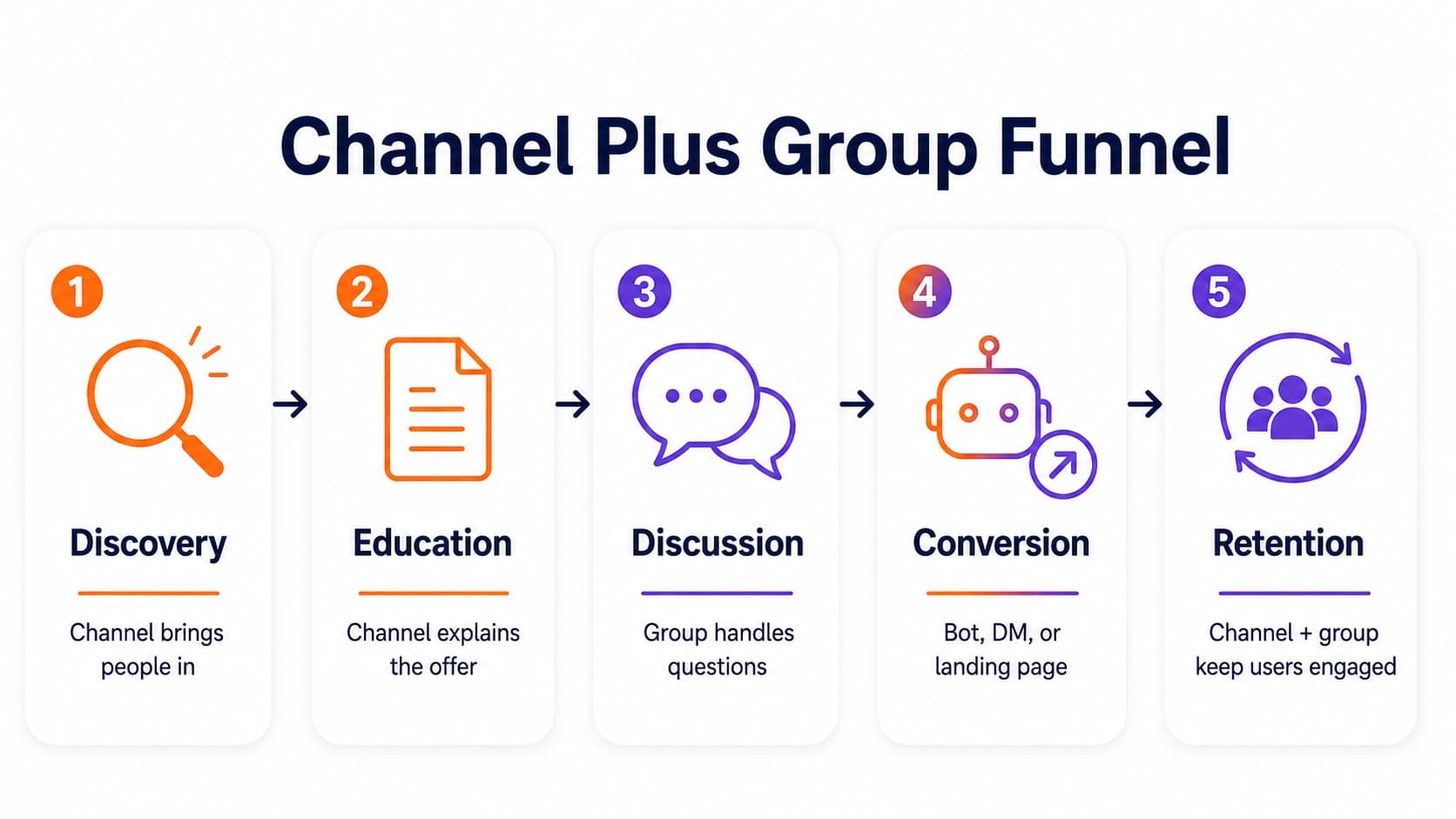
A simple hybrid funnel works like this: the channel attracts people through posts, forwards, ads, search, and external links. The channel then educates them with useful content and proof.
The linked group handles questions, objections, peer discussion, and support. Conversion can happen through a bot, landing page, direct message, or offer post. Retention depends on both spaces: the channel keeps value flowing, while the group keeps people involved.
| Funnel Stage | Best Telegram Format | What Happens There | Metric to Watch |
|---|---|---|---|
| Discovery | Public channel | Users find posts through forwards, search, ads, directories, or external links | New subscribers, source links, first post views |
| Education | Channel | The brand publishes useful posts, guides, examples, and proof | View rate, forwards, reactions, link clicks |
| Consideration | Linked group | Users ask questions, compare options, read peer discussion | Active members, questions asked, admin response time |
| Conversion | Channel, bot, landing page, or DM flow | Users join, book, buy, start a bot, or request more info | Cost per join, lead, demo, purchase, or bot start |
| Retention | Group and channel | The channel keeps value flowing, the group keeps users involved | Repeat views, churn, active member ratio |
| Monetization | Channel first, group second | Ads, sponsored posts, paid access, affiliate offers, services | CPM, fill rate, paid conversion, renewal rate |
Telegram Group vs Channel for Advertising
For advertisers, a Telegram channel is usually the easier first test. The format is clear: one sponsored post, one publishing time, one link, visible views, and a defined audience. This makes channels easier to compare by CPM, clicks, joins, leads, or sales.
A Telegram group works differently. A group placement is closer to a community partnership than a standard media buy. The result depends not only on audience size, but also on admin trust, discussion quality, moderation, timing, and how naturally the offer fits the conversation.
Use channels when you need predictable reach, clean tracking, and a simple test structure. A channel placement works best for product announcements, app installs, lead magnets, newsletters, launches, ecommerce offers, and other campaigns where the user can act after reading one clear post.
Use groups when the offer needs explanation or trust before conversion. A group can work well for SaaS tools, education products, finance communities, Web3 projects, local services, and high-consideration offers where people want to ask questions before taking action.
A group placement can outperform a channel when:
- the admin introduces the offer naturally;
- the community already discusses the problem your product solves;
- members can ask questions after the placement;
- the format includes Q&A, AMA, pinned post, or a limited-time community offer;
- the offer adds value to the group instead of interrupting it.
A group can underperform when it is spammy, poorly moderated, too broad for the offer, or overloaded with promotions. In that case, even a large member count does not mean real advertising value.
For most advertisers, the safest sequence is simple: test channels first, then test selected groups when the offer needs discussion, trust, or community endorsement.
For detailed ad buying workflows, see: How to Find Telegram Channels and Groups for Advertising
Official Telegram Ads vs Direct Placements
Official Telegram Ads are different from direct placements. They run as sponsored messages in public Telegram channels with 1,000+ subscribers, and their links must lead to a Telegram channel or bot. Direct placements are negotiated with channel admins and can use native posts, longer copy, visuals, pinned formats, external links, coupons, or bot start links.
If your goal is to grow a Telegram channel or bot, official ads may fit the funnel. If your goal is to send users to a landing page, checkout page, app store listing, or external lead form, direct placements or network-based buying are usually more flexible.
For a deeper comparison of Telegram ad buying methods, see: How to Run Telegram Ads in 2026
How to Decide
Use this decision process before creating a Telegram space.
- Define the primary job. If the main job is publishing, start with a channel. If the main job is conversation, start with a group.
- Decide how much control you need. If every post must match brand, legal, or editorial standards, a channel is safer.
- Estimate moderation capacity. If nobody can moderate daily, do not open a large public group too early.
- Choose the measurement model. If you need views, CPM, clicks, and clean ad tests, a channel is easier.
- Plan the next step. A channel can later add a discussion group. A group can later add an announcement channel. You do not need to solve everything on day one.
Common Mistakes
Mistake 1: Starting a Group Because "Engagement Is Good"
Engagement is only useful when it supports the business goal. A busy group with low-quality messages can hurt the brand. Before opening a group, decide who moderates, what topics are allowed, how spam is handled, and what the group should produce for the business.
Mistake 2: Using a Channel as a Support Desk
A channel is poor at support because subscribers cannot naturally open public conversations inside the feed. If support is central, use a group, bot, helpdesk, or channel direct messages where appropriate.
Telegram added direct messages for channels, allowing subscribers to contact channel owners and admins privately when enabled. This can help creators and brands handle some communication without exposing personal accounts.
Mistake 3: Measuring Groups Like Channels
A group is not weak just because it has fewer views. Its value may be in member questions, peer recommendations, testimonials, user feedback, or reduced support load.
Measure groups by active members, quality of discussion, response time, spam rate, recurring questions, and business outcomes.
Mistake 4: Measuring Channels Only by Subscribers
Subscriber count is easy to misunderstand. A smaller channel with strong recent views can be more valuable than a larger channel with weak attention. For advertising, always compare recent average views, audience fit, ad density, and cost per result.
Mistake 5: Mixing Announcements and Chat in One Place
When everything happens in one group, important posts disappear. If the community becomes active, create a channel for announcements and keep the group for discussion.
Recommended Setups by Business Type
| Business Type | Recommended Setup | Why It Works | Watch Out For |
|---|---|---|---|
| Media publisher | Public channel, optional discussion group | Clean feed, easy sharing, measurable views | Comments can become hard to moderate if news is sensitive. |
| SaaS company | Channel plus support or community group | Channel educates, group handles onboarding and feedback | Do not let the group replace proper support workflows. |
| Ecommerce brand | Channel for drops and offers, group only if community matters | Fast promotion and repeat visibility | Too many promo posts can cause churn. |
| Course creator | Public channel, private paid channel, private group | Channel attracts, paid channel delivers lessons, group supports students | Group needs clear rules and active facilitation. |
| Local service business | Channel for updates, group for local discussion if needed | Useful for announcements, events, and trust-building | Public groups can attract spam without moderation. |
| Web3 or crypto project | Channel for official updates, group for community and support | Separates verified information from discussion | High moderation and scam risk. |
| B2B community | Group first, channel later | Peer discussion is the core value | Without facilitation, the group may go quiet. |
| Advertiser | Buy channels first, test groups selectively | Channels are easier to measure and compare | Groups need contextual, community-safe placements. |