This guide covers sustainable, legitimate growth methods for Telegram channels. We do not recommend fake subscribers, bot traffic, spam, or gray-area tactics. Every approach here focuses on real audience retention, measurable reach, and long-term channel value.
Most channels had the same problem: they started buying traffic before fixing their onboarding. The result was predictable - subscriber counts went up, view rates collapsed, and budgets were wasted. The order matters. Optimize first, distribute second, pay third.
Sara Al MansooriAdTech Strategist at MangoAds.
This guide follows a practical promotion sequence: optimize the channel first, build a repeatable content system, use free distribution channels, test paid acquisition, and measure retention before scaling.
The Fastest Safe Way to Grow a Telegram Channel
If you have 10 minutes right now, here is the minimum viable promotion plan. It covers setup, content, distribution, and measurement in that order.
- Set your channel to public, claim a clean username, write a keyword-rich bio, and pin a welcome post.
- Build a 7-day content plan with a clear value loop and one CTA per post.
- Activate three free distribution channels: cross-promotion with similar channels, submission to relevant directories, and promotion on your existing social profiles.
- Add two paid levers when ready: direct placements in vetted channels and a structured CPM campaign via an ad network.
- Track three metrics weekly: view rate, join-to-view ratio, and churn after each promotion.
Who This Guide Is For
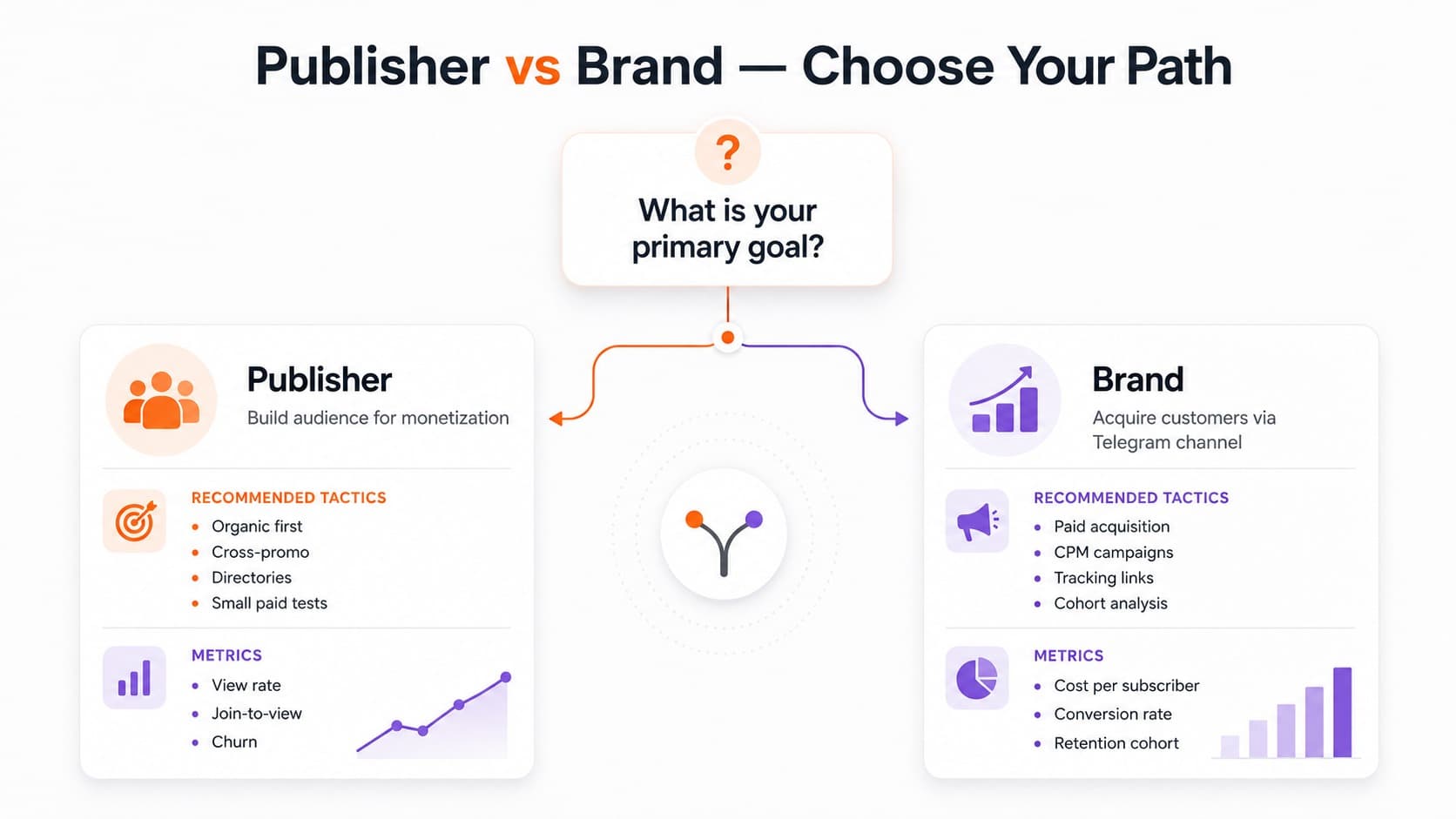
Beginner publishers - build an audience you can monetize. If you are starting a Telegram channel to eventually earn from it, focus on engaged subscribers who actually read your posts, not just on subscriber count.
The path looks like this: pick a specific niche, post consistently, optimize your welcome experience, and grow organically first. Once your view rate is stable and your content system is running, add small paid tests.
Brands & advertisers - acquire targeted customers, not just subscribers. If you are a brand or marketing team running a corporate Telegram channel, the main question is whether subscribers match your target market and move through the funnel. A channel with 2,000 highly relevant followers who click links and convert can be more valuable than a channel with 20,000 passive followers.
Your focus should be segmentation, paid acquisition with proper tracking, and ROI measurement. Before buying any traffic, define what a "good subscriber" looks like for your funnel: someone who joins, reads, and eventually takes an action, such as clicking a link, visiting a landing page, requesting a demo, or making a purchase.
Brand safety matters too. Know which channel categories your ads appear in, and use platforms that give you visibility into placements. Before committing a budget, build a short exclusion list of channel categories that conflict with your brand values.
A financial services brand, for example, may want to exclude entertainment channels with high churn audiences or verticals where the message will feel out of place.
Why Telegram Channel Promotion Matters
What Makes Telegram Different
Telegram gives publishers and brands something many social platforms do not: direct access to an audience that actively subscribes to a channel.
A Telegram channel works as a broadcast space. When you publish, subscribers can see the post in their chat list. There is no TikTok-style feed where every channel must compete for algorithmic distribution in the same way.
That makes Telegram attractive for media, creators, communities, SaaS companies, ecommerce brands, education projects, finance publishers, crypto communities, and niche B2B teams.
But Telegram also has a real discovery challenge. Growth does not happen automatically. A new channel will not usually receive a steady stream of subscribers just because it exists. Promotion depends on a mix of search, referrals, forwarded posts, cross-promotion, directories, external platforms, and paid traffic.
The practical implication is simple: once someone joins your channel, retention depends mostly on content quality, onboarding, posting consistency, and audience fit. That is a meaningful advantage for anyone building a long-term audience.
Telegram Discovery Is Real, But Limited
Telegram is not a closed system where growth happens only through paid placements. Public channels can be found through search, shared links, forwarded posts, hashtags, directories, Similar Channels, and external platforms.
The main limitation is predictability. You cannot expect Telegram itself to send steady daily traffic to your channel. Telegram growth usually comes from combining several smaller sources:
- Search and usernames help people find you when they already know what they want.
- Similar Channels can expose you to adjacent audiences.
- Forwards help your best posts travel beyond subscribers.
- Directories create passive discovery.
- Cross-promotion and paid placements give you controlled distribution.
Telegram does not have a TikTok-style recommendation feed that reliably pushes every new channel to a broad audience. However, it does have discovery surfaces such as Similar Channels, where users can find public channels selected automatically based on subscriber-base similarity. Treat these surfaces as secondary discovery, not as a growth engine you fully control.
This is why Telegram promotion should be planned as a system. One tactic rarely builds a strong channel on its own. The best results come from combining a clear channel promise, consistent content, and several distribution sources that match the same audience.
Prepare Your Channel Before Promotion
Promotion without onboarding increases churn. Optimize your welcome experience before buying any traffic. Otherwise you are paying to fill a leaky bucket.
Sara Al MansooriAdTech Strategist at MangoAds.
This step is not optional. Sending traffic to an unoptimized channel wastes budget and distorts your metrics. Get the foundation right first.
Make the Channel Public and Claim a Clean Username
Set your channel to public before serious promotion. A private channel cannot be discovered through search in the same way and is harder to share broadly.
Your username should be short, readable, and aligned with your brand or niche. Avoid unnecessary underscores, numbers, and long generic names.
Good examples:
- @financeinsights
- @techweekly
- @saasgrowthnotes
Avoid:
- @my_channel_2026_official_v2
- @besttips12345
- @daily_random_business_news_channel
Think of your Telegram username as a domain name. It should be memorable, easy to type, and self-explanatory.
Telegram SEO: Name, Bio, and Keywords
Telegram's internal search can surface public channels by username and visible channel name. Put your primary topic in the channel name naturally, so both searchers and new visitors can quickly understand what the channel is about.
"Finance Insights - Weekly Market Analysis" is clearer than "Finance Insights" alone because it explains the channel's focus before a user opens it. It also gives Telegram search more relevant words to match against, although visibility still depends on other factors.
Your bio should answer five questions in 3-5 lines:
- Who is this for?
- What do you post?
- How often?
- Why should readers trust you?
- What should they do next?
Use one CTA link in the bio. Not five. One.
If you have multiple destinations, pick the most important one and link to a landing page that handles the rest.
Design for Trust - Avatar, Visual System, Post Templates
Your avatar is the first thing people see in search results, forwarded posts, and channel previews. Use high contrast, a clear symbol or logo, and avoid small text that becomes unreadable at thumbnail size.
Post templates create visual consistency. A simple structure works well:
- Short headline.
- 3-5 key points or a brief narrative.
- One CTA line.
- A "forward if useful" prompt when relevant.
Consistency builds recognition. Readers start to associate your visual style with quality content.
Pin a High-Converting Welcome Post
Your pinned post should help a new subscriber understand where to start. Do not repeat the bio word for word. Use this space to give proof, examples, and a clear next step.
For a publisher, link to 3 strong posts that show the channel's real value. For a brand, point readers to the most useful next action: a product guide, case study, checklist, webinar, or offer. Keep the post focused on one action, not several competing links.
Lead Magnet and Onboarding Flow
A lead magnet can improve channel conversion when it gives new subscribers something specific and useful right away. For example, a marketing channel might offer a short audit checklist, a SaaS brand might share a product guide, and an education channel might give access to a mini-course or template.
The resource must match the channel topic closely. A generic "free ebook" may attract people who only want the download and leave soon after. A niche-specific resource brings in subscribers who are more likely to keep reading because the channel continues to deliver the same kind of value.
Keep the onboarding flow simple:
- Add the lead magnet to your pinned welcome post or bio.
- Use one clear CTA, not several competing links.
- Create unique invite links for each traffic source.
- If you use a bot, ask users to tap “Start” before expecting private message delivery.
- Avoid sending several automated messages before the user has read your channel.
Do not promise an automatic private message unless the flow supports it. In Telegram, a bot generally cannot message a user first until that user has contacted the bot. A safer setup is to place a visible button or link in the welcome post, send users to the bot, and deliver the resource after they tap “Start”.
Use automation for clarity and attribution, not for pressure. The first experience should help a new subscriber understand what the channel is about, where to start, and why it is worth staying.
Free Promotion Methods
Free methods take more time but often build a more durable audience. Subscribers earned through value-first distribution tend to have higher retention than subscribers acquired through broad paid campaigns.
1) Leverage Existing Traffic
If you already have a website, email list, social media following, customer base, or offline audience, these are your fastest path to the first 100-500 subscribers.
- Website: add a Telegram join banner or CTA block. Place a "Join our Telegram" CTA in your header, footer, and relevant blog posts.
- Email: add a Telegram invite link to your email signature and send a dedicated "we're on Telegram" announcement to your list. Use a trackable invite link so you can measure conversion.
- Social profiles: pin a post about your Telegram channel on X, LinkedIn, Instagram, YouTube, or TikTok. Add the link to your bio on every platform.
2) Cross-Promotion with Similar Channels
Cross-promotion is one of the most effective free growth methods for channels above 500 subscribers. The principle is simple: you post about their channel, they post about yours. Both audiences get a relevant recommendation.
Look for partners with:
- The same niche or an adjacent topic.
- Similar language and geography.
- Comparable average post views.
- A posting frequency that matches yours.
- An audience that would genuinely care about your content.
Check their recent posts before agreeing to anything. If they run 5 ads per day, their audience is probably ad-fatigued and your placement may underperform.
A useful rule: negotiate based on views, not subscribers.
A channel with 5,000 subscribers and 2,000 views per post is a stronger partner than a channel with 10,000 subscribers and 800 views per post. Calculate the average views per post for both channels and aim for a fair exchange of real attention.
If your channel averages 1,500 views and theirs averages 3,000, consider offering two posts in exchange for one of theirs.
When I evaluate a cross-promo partner, I look at views first and subscribers second. Subscriber count is easy to inflate. Stable views across recent posts are much harder to fake and usually tell you more about real audience quality.
Sara Al MansooriAdTech Strategist at MangoAds.
Outreach Template for Cross-Promotion
Hi [Channel Name],
I run [Your Channel], a channel about [topic] with [X] subscribers and an average of [Y] views per post.
I think our audiences overlap well. Would you be open to a mutual post exchange?
Suggested format: one post each, same day, similar post length.
I can send a stats screenshot and a draft post for review.
Let me know if this could work.
[Your Name]
How to Check Whether a Cross-Promo Worked
Do not judge a cross-promo by new subscribers alone. A weak partner can send joins that disappear in a few days or never read your posts.
Track each exchange with a unique invite link and record:
- Partner channel.
- Date and post format.
- Partner's average post views.
- New subscribers gained.
- Views from the new cohort after 7 days.
- Unsubscribes in the first 48-72 hours.
A good cross-promo brings subscribers who behave like your existing audience. If the join count is high but the new cohort does not read, the audience match was weak or the promotional message overpromised.
3) Submit to Free Telegram Directories
Telegram directories and catalogs list channels by category and allow users to browse by topic. Submitting to 3-5 credible directories can generate passive organic joins over time.
Start with quality, not quantity. Submit to several relevant directories first, then check whether they actually send subscribers before adding more.
Directories to consider:
- TGStat: large channel index and analytics platform.
- Telega.io: catalog and ad exchange with category filtering.
- Telegram Channels: browsable directory by topic.
- TgramSearch: search-indexed Telegram channel directory.
- Relevant niche-specific catalogs in your language or region.
To submit, you usually need:
- Public channel link
- 100-200 character description
- Category
- Language
- Keywords or tags
- Channel avatar and basic metadata
Write the description once, optimized for clarity and your primary topic, then adapt it for each directory.
Avoid directories with no moderation, no category system, no visible activity, or thousands of low-quality listings. Mass-submitting to weak catalogs rarely produces quality subscribers.
4) Engage in Niche Groups and Forums
Find Telegram groups, Reddit communities, Quora spaces, Discord servers, Facebook groups, and niche forums where your target audience already spends time.
Participate genuinely:
- Answer questions
- Share useful examples
- Give practical advice
- Join discussions without leading with a link
- Mention your channel only when it is relevant
The rule is value first, CTA second. A comment that leads with "join my channel" gets ignored or removed. A comment that solves a problem and mentions your channel as a resource can drive qualified clicks.
Value-First Comment Template
Great question. The short answer is [direct answer to their question].
A few things worth knowing:
- [Point 1 - specific and useful]
- [Point 2 - adds nuance]
- [Point 3 - practical next step]
I cover this topic regularly on my Telegram channel [link] if you want a longer breakdown.
5) Create Shareable Post Formats
Some content formats spread naturally on Telegram. Polls and quizzes generate reactions. Checklists get saved and forwarded. Post series create anticipation and return visits.
Formats that often work:
- Checklists
- Short frameworks
- Before/after examples
- Data summaries
- Mistake lists
- Templates
- "What I would do if..." posts
- Curated weekly roundups
- Step-by-step mini-guides
Add a forward prompt to your best posts: "If this was useful, forward it to someone who needs it."
It sounds simple and it works. Readers who would not think to share on their own often will when prompted.
6) Repurpose Content to External Platforms
One strong idea can drive discovery from multiple directions. A Telegram post can become a LinkedIn article, a Medium piece, a short video script, a newsletter section, or an X thread.
The principle: one idea, five formats. This multiplies distribution without multiplying content creation effort.
Repurposing flows that work:
- Blog/Telegram: publish a summary or key takeaway on your channel, with a link to the full post.
- Podcast/Telegram: share one quote or insight from each episode.
- X thread/Telegram: adapt popular threads as channel posts.
- YouTube/Telegram: publish "what's coming" previews before videos go live.
- Webinar/Telegram: turn key points into a post series.
Passive automation can help if you publish regularly. For example, an RSS-to-Telegram bridge can push new blog posts to your channel automatically. Tools like IFTTT, Make, or dedicated Telegram RSS bots can handle this.
This is useful for brand channels that publish regular blog content. Every new article becomes a Telegram post, keeping the channel active even when the team is focused on other tasks.
7) Use Telegram Hashtags for Extra Discovery
Telegram hashtags can help public posts and Stories become easier to find, especially after Telegram expanded public post search and hashtag discovery features. This does not mean hashtags guarantee traffic. Treat them as a low-effort discovery signal, not as a replacement for promotion.
How to use hashtags:
- Add 1-3 relevant hashtags to posts that have long-term value
- Use specific tags instead of broad generic tags
- Keep the same core hashtags across recurring topics
- Avoid hashtag stuffing
- Track whether posts with hashtags bring more forwards, profile visits, or joins
For example, a fintech channel may use tags like #marketanalysis or #fintechnews rather than a broad tag like #news. A marketing channel may use #telegramads, #mediabuying, or #growthmarketing when the post is directly relevant.
Hashtags are most useful when the content itself is strong enough to be opened, saved, or forwarded. They help discovery, but they do not create demand by themselves.
Paid Promotion Strategies
Paid promotion accelerates growth, but it does not fix a broken channel. Before spending, confirm that your view rate is stable, your welcome post is clear, and you have tracking links in place.
Budget Benchmarks at a Glance
These are directional ranges, not guarantees. Actual results depend on niche, creative quality, channel readiness, targeting, pricing, and traffic source.
| Budget Tier | What You Can Do | Typical Outcome | Biggest Constraint |
|---|---|---|---|
| $0 | Cross-promo, directories, content repurposing, group engagement | Slow but high-quality growth | Time and consistency |
| $100-500 | 2-5 direct placements in small or medium channels | Small targeted subscriber tests | Manual vetting effort |
| $500-2,000 | CPM campaigns via ad network, multiple direct placements | Larger tracked tests and early optimization | Creative quality and targeting setup |
| $2,000+ | Scaled CPM campaigns, Telegram Ads, multi-channel strategy | Consistent, measurable acquisition with optimization | Attribution complexity and content readiness |
Do not treat these ranges as promises. Use them for planning, then validate with your own data.
Option A - Direct Ad Placements
Direct placements mean paying a channel admin to publish your post to their audience. This is one of the most common paid methods for Telegram channel promotion and can be effective when done carefully.
Direct ad placements require manual vetting but can offer strong niche targeting.
Before buying, request recent statistics and check:
- View rate: views divided by subscriber count.
- View consistency: stable views are better than sudden spikes.
- Ad frequency: too many paid posts can signal audience fatigue.
- Content relevance: the channel should match your offer.
- Recent growth pattern: sudden subscriber spikes without content changes can be suspicious.
- Audience geography and language: the audience must match your campaign.
Below 10% view rate can be a warning sign. A 20-40% view rate can be strong in many niches, but context matters. Some entertainment channels may run lower, while specialized professional channels may run higher.
Ask for examples of past integrations and, if possible, the results they generated.
Pricing and Negotiation
Most direct placements are priced as a fixed fee per post. A 24-hour placement is common. CPM-based pricing is less common in direct deals but can be negotiated for larger buys.
Always use a UTM-tagged link, tracked Telegram invite link, or unique landing destination so you can measure joins. For larger buys, ask for a report screenshot after 24 hours.
| Channel Size | Typical Price per Post | Notes |
|---|---|---|
| 1,000-10,000 subscribers | $10-50 | Test budget, low risk |
| 10,000-100,000 subscribers | $50-500 | Core growth budget range |
| 100,000+ subscribers | $500-5,000+ | Requires strong creative and clear ROI tracking |
Price per post is not the right metric on its own. Divide the cost by the channel's average views per post, not subscriber count, to get an effective CPM.
A channel with 50,000 subscribers and 2,000 views per post can be worse than a channel with 10,000 subscribers and 4,000 views per post at the same price.
A direct placement should be judged by effective CPM and post-promotion retention, not by the admin's price alone. A cheap post in a weak channel can be more expensive than a premium placement in a smaller but highly active channel.
Sara Al MansooriAdTech Strategist at MangoAds.
Creative Fit Matters More Than Ad Length
A Telegram ad does not need to be long to work. It needs to match the channel where it appears and the expectation of the reader.
A weak ad says: "Join our channel for useful marketing insights."
A stronger ad says: "We break down real Telegram ad placements, CPM tests, channel vetting mistakes, and campaign examples. Join if you buy or sell traffic in Telegram."
The second version works better because it tells the reader exactly what they will get. Before buying a placement, write the ad in the language of that channel's audience. A finance audience, a crypto audience, and a B2B SaaS audience should not see the same generic copy.
Option B - Official Telegram Ads Platform
Telegram Ads is the official advertising platform for sponsored messages in Telegram. Sponsored messages appear in large public one-to-many channels, and Telegram's documentation describes the platform as a way to create ads in public channels with 1,000+ subscribers, choose where ads are displayed, and monitor campaign performance.
This option is best suited for advertisers who want an official buying environment, predictable campaign controls, and placement inside Telegram's native channel ecosystem.
Before launching, check the live Telegram Ads interface for current requirements. Pricing and account rules can change, and Telegram Ads are tied to TON-based bidding. Telegram's public documentation states that the minimum CPM for a sponsored message is 0.1 Toncoin, but the practical cost of a campaign depends on audience, competition, targeting, and the TON exchange rate at the time of launch.
Use Telegram Ads when you already have:
- A clear channel or bot destination. Users should land in a place that is ready to convert: a structured channel, a pinned welcome post, a bot flow, or a simple Telegram-based funnel. Do not send paid traffic to an empty or unclear channel.
- A short, compliant sponsored message. The ad should be specific, easy to understand, and aligned with Telegram Ads rules. Avoid vague claims, aggressive wording, and promises your channel cannot support.
- A tracking plan for joins, starts, clicks, and retention. Decide before launch how you will measure the campaign. Track how many users join, start the bot, click links, read posts after joining, and stay after 7 or 30 days.
- A realistic test budget. The budget does not have to be large, but it should be enough to produce useful data. If the test is too small, results may be random and hard to interpret.
- A way to compare paid cohorts against organic subscribers. Compare users from Telegram Ads with subscribers from search, cross-promotion, directories, or existing social profiles. If paid users read, click, and stay at a similar or better rate, the campaign may be worth scaling.
Telegram Ads can help you reach relevant users at scale, but it should not be treated as a shortcut around content quality. If your welcome post is weak or your channel has no clear value proposition, official traffic will expose that problem quickly.
Option C - Telegram Channel Promotion via Ad Networks
Ad networks automate the process of buying placements across multiple channels. Instead of negotiating with individual admins, you set targeting parameters, upload creatives, define a budget, and the network handles distribution.
For a comparison of leading platforms and features, see: 10 Best Telegram Advertising Networks.
The advantages are speed, scale, and reporting. The risks are traffic quality and transparency. Not all networks vet their channel inventory carefully.
When evaluating any ad network, ask:
- How do they detect bot traffic?
- Can you see which channels your ads ran on?
- Can you exclude categories that do not fit your brand?
- What happens if invalid traffic is detected?
- Can you pause campaigns mid-flight?
- What reporting is available after the campaign?
Before spending, check whether the network provides:
- A list of channels where your ads are planned to appear or have already appeared.
- A documented anti-fraud methodology.
- Credits or refunds for verified invalid impressions.
- Category exclusions, such as adult content, gambling, or unrelated verticals.
- A CPM floor that filters out very low-quality inventory.
- The ability to pause campaigns without penalty.
- Transparent reporting at the campaign or placement level.
Option D - External Paid Traffic to Telegram
Running Meta, Google, TikTok, or other external ads that drive users to a Telegram channel is possible, but it often produces a higher cost per engaged subscriber than Telegram-native placements.
It can make sense when:
- You have a strong lead magnet.
- The user lands on a clear welcome post, bot, or landing page.
- Your target audience is active on that external platform.
- You can track downstream conversions.
- The goal is broader funnel growth, not only channel readership.
Sending cold external traffic directly to an empty channel usually produces weak retention. A user clicking from Facebook, Google, or TikTok is in a different mindset than a user already browsing Telegram content.
External traffic is best used when the Telegram channel is part of a wider funnel.
Option E - Sponsored Giveaways and Contests
Giveaways can generate a fast awareness spike, but they should be used carefully.
The critical rule: the prize must match your niche. A generic prize, such as cash or a phone, attracts everyone and retains almost no one. A niche-specific prize attracts the right people and produces subscribers who are more likely to stay.
Examples:
- Marketing channel: free audit, course, tool subscription, template pack.
- Ecommerce brand: product bundle from the same category.
- Finance channel: premium report or paid community access.
- SaaS brand: annual subscription, setup support, or expert session.
Use giveaways for awareness, not as the main growth strategy. After the campaign, measure churn, view rate, and link clicks from the new cohort.
Also check local regulations on prize promotions. Eligibility, winner selection, disclosure, and prize delivery rules vary by jurisdiction.
| Method | Speed | Targeting Control | Cost Predictability | Fraud Risk | Creative Complexity | Best For |
|---|---|---|---|---|---|---|
| Direct placements | Fast | High | Low | Medium | Low | Publisher + Brand |
| Telegram Ads | Medium | Medium | High | Low | Medium | Brand |
| Ad networks | Fast | Medium-High | High | Medium | Low | Brand + Publisher |
| External paid traffic | Medium | High | Medium | Low | High | Brand |
| Sponsored giveaways | Fast | Low | Low | Low | Medium | Brand awareness |
Scaling Paid Promotion with MangoAds
MangoAds is a CPM-based Telegram advertising platform built for brands that want to scale distribution and channel owners who want to monetize their inventory through automated ad placements. Instead of negotiating with channel admins one by one, advertisers can set campaign parameters, choose targeting by channel category, geography, language, and channel size, upload creatives, and launch across relevant Telegram channels from a single dashboard.
Campaign performance can be tracked in real time through metrics such as impressions, clicks, spend, and CPM, while MangoAds uses anti-fraud systems to filter invalid traffic and protect budget.
This option makes sense when your channel is already ready for paid traffic: the welcome post is clear, content is published consistently, tracking links are prepared, and you know which audience you want to reach. MangoAds can help you test placements faster and evaluate performance across different audience segments, categories, or GEOs.
Use it as a scaling tool, not as a substitute for strategy. Before launching a campaign, define your target audience, creative angle, budget cap, exclusion categories, and the retention metric you will use to judge subscriber quality. The goal is not just to buy more joins, but to find traffic sources that bring subscribers who continue to read, click, and stay.
Go/No-Go Checklist Before Scaling Paid Traffic
Before scaling any paid campaign through MangoAds or any other network, check the following:
- View rate baseline is established from at least 2 weeks of data.
- Pinned welcome post is live and tested.
- Churn rate after previous promotions is within an acceptable range for your niche.
- Unique tracking links are set up per traffic source.
- Content cadence is consistent.
- Moderation is active where needed.
- Budget cap is defined for the test phase.
- Reporting cadence is scheduled.
- Brand-safety exclusion list is ready.
- Campaign creative matches the channel promise.
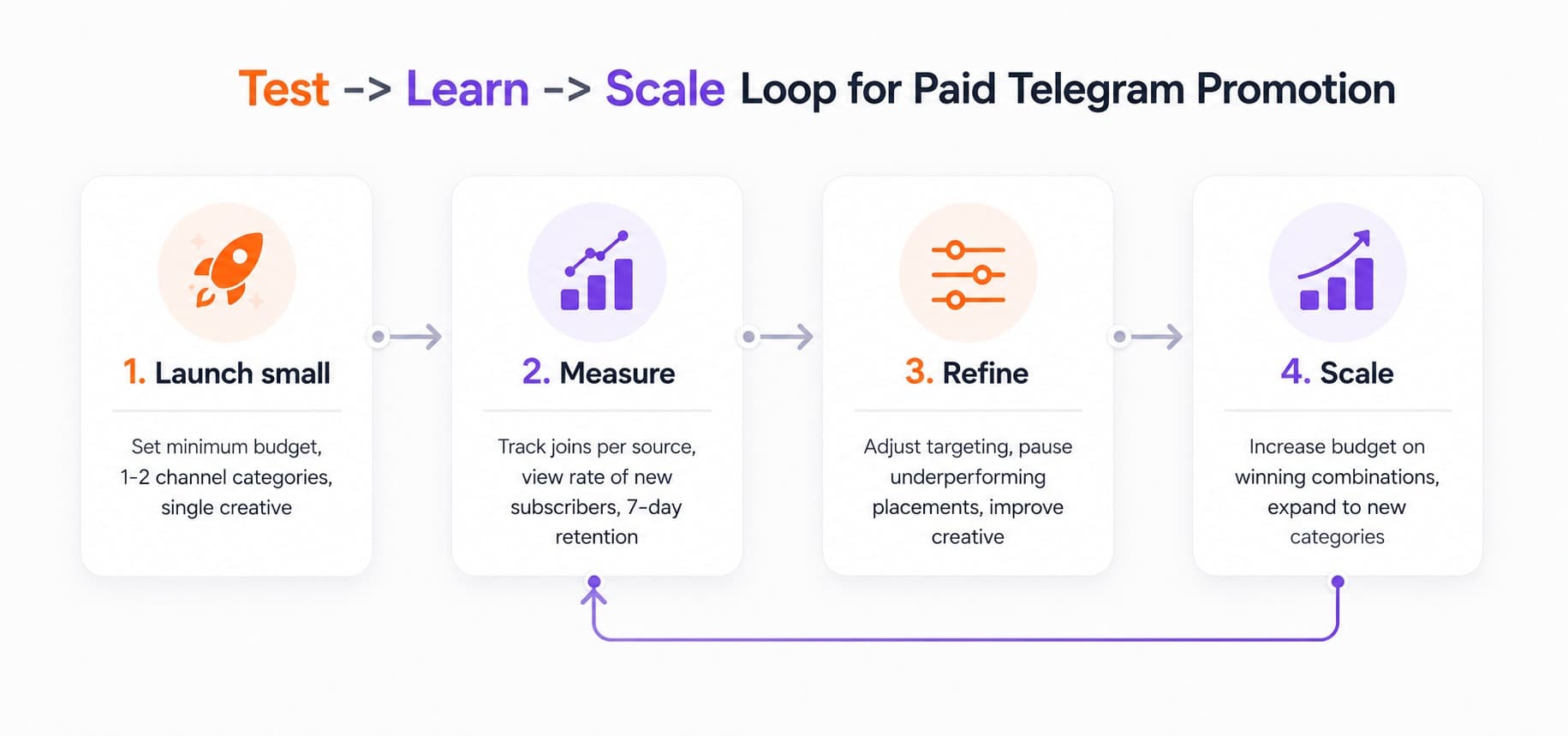
The test-learn-scale loop for paid Telegram promotion:
- Launch small: set a minimum budget, 1-2 channel categories, and one or two creatives.
- Measure: track joins per source, view rate of new subscribers, and 7-day retention.
- Refine: adjust targeting, pause weak placements, and improve creative.
- Scale: increase budget on winning combinations, then return to measurement.
For a full walkthrough of running campaigns, see: How to Run Telegram Ads.
Promotion Strategy by Channel Size
0 to 100 Subscribers
At this stage, the goal is not growth at any cost. It is validation. You are testing whether your niche, format, and posting style resonate with real people.
Use your immediate network: colleagues, friends in the industry, existing social followers, email subscribers, and early customers.
Post in 2-3 relevant Telegram groups with value-first contributions. Submit to 3-5 credible directories. Do one small cross-promo if you can find a willing partner.
The metric that matters here is not raw subscriber count. It is whether the same people keep reading your posts.
If your first 50 subscribers produce strong repeat views, you have something worth building. If they join and stop reading, fix the content before adding more people.
Your First 4 Weeks
| Week | Focus | Actions |
|---|---|---|
| 1 | Setup | Set channel to public, claim username, write bio, pin welcome post, create tracking links |
| 2 | First distribution | Publish 3 shareable posts, identify 5 cross-promo partners, submit to 3-5 directories |
| 3 | Community and credibility | Participate in groups, repurpose one strong post, follow up with partners |
| 4 | Evaluate and test | Check best posts, review joins by source, run a small paid test only if content metrics are stable |
100 to 1,000 Subscribers
Now the goal is building a reliable content system and improving welcome conversion. Subscribers are arriving, but not all of them stay. Your job is to understand why.
Run regular cross-promos, repurpose your best content to external platforms, and test one small paid placement if organic engagement is healthy.
Compare paid subscribers against organic subscribers at 7 and 30 days. If paid traffic brings cheap joins but weak views, the source is not aligned with your channel.
Track weekly:
- View rate
- Join-to-view ratio
- Forward rate
- Churn after each promotion
- Best-performing post format
If view rate declines as you grow, your content may not be keeping pace with audience expectations.
1,000 to 10,000 Subscribers
At this stage, you need a systematic approach to distribution. Manual cross-promos and occasional posts are not enough.
Build a content calendar with recurring formats:
- Weekly roundups
- Data posts
- Expert takes
- Audience polls
- Case breakdowns
- Curated links
- Practical checklists
Establish 3-5 regular cross-promo partners. Start running CPM campaigns through an ad network with proper tracking. For brands, this is also a good stage to test Telegram Ads with a clear campaign structure.
The key metric shifts from cost per subscriber to cost per engaged subscriber.
A subscriber who reads 30% of your posts is much more valuable than one who joins and never opens the channel again.
10,000+ Subscribers
Large channels face a different problem: maintaining engagement as the audience diversifies.
Not everyone who joined at 1,000 subscribers has the same interests as someone who joined at 8,000. Content needs clearer segmentation and stronger recurring formats.
Focus on:
- Content series that reward loyal readers.
- Post formats that drive forwards.
- Link click analysis.
- Cohort analysis by traffic source.
- Monetization fit.
- Ad frequency control.
- Audience surveys.
- Partnerships with relevant brands.
If you are a publisher, this is the stage where monetization becomes more realistic through direct placements or automated systems.
If you are a brand, compare the behavior of subscribers acquired through different sources and campaigns. Double down on the sources that produce high-retention subscribers.
| Stage | Main Objective | 3 Best Tactics | Avoid | KPI |
|---|---|---|---|---|
| 0-100 | Validate niche and format | Existing network, niche groups, directories | Paid traffic before content is proven | Repeat viewer rate |
| 100-1,000 | Build content system + welcome conversion | Cross-promos, repurposing, small paid test | Scaling before view rate is stable | View rate, join-to-view |
| 1,000-10,000 | Systematic distribution | CPM campaigns, regular cross-promos, content calendar | Ignoring churn signals | Cost per engaged subscriber, churn |
| 10,000+ | Retention, segmentation, monetization | Content series, cohort analysis, collaborations | Chasing raw subscriber count | Retention cohorts, revenue per subscriber |
"Good" view rate varies significantly by niche. Finance, crypto, entertainment, education, and professional channels can behave very differently. Use benchmarks as orientation, not fixed targets.
Track Performance and Prove ROI
Core Metrics for Telegram Channel Growth
Four metrics tell you most of what you need to know:
- View rate is views divided by subscribers, expressed as a percentage. It is the primary health indicator for a Telegram channel. A declining view rate while subscriber count grows means your new subscribers are not engaging.
- Engagement proxies include forwards, link clicks, poll responses, reactions, and replies. Telegram does not expose all engagement data natively, but forwards and link clicks through tracked URLs are useful signals.
- Churn after promotions measures how many subscribers leave in the 48-72 hours after a paid campaign or cross-promo. High post-promotion churn means the traffic source was misaligned with your content.
- Join-to-view ratio measures how many people who saw your ad actually joined and then read your posts. A high join rate with weak subsequent views often means the ad creative overpromised what the channel delivers.
Day-one joins are the easiest metric to celebrate and the easiest metric to misread. The useful question is what happens after the user joins: do they read, click, forward, and stay after 7 or 30 days?
Sara Al MansooriAdTech Strategist at MangoAds.
Tracking Sources with Custom Invite Links
Create a unique invite link for every traffic source. Use a consistent naming convention: source_campaign_date
Examples:
- crosspromo_financechannel_jan2026
- mangoads_test1_feb2026
- tgstat_directory_mar2026
- linkedin_profile_apr2026
Store these in a simple spreadsheet with columns for:
- Source name
- Invite link
- Date created
- Campaign type
- Subscribers joined
- 7-day view rate
- 30-day retention
- Link clicks
- Notes
This becomes your attribution database and shows which sources produce the best long-term subscribers.
Analytics Tools and Bots
Telegram's native analytics can show subscriber growth, views, and basic engagement data for eligible channels. For more granular tracking, third-party tools such as TGStat and Telemetr can provide historical data, channel comparison, and audience analysis.
For a more detailed comparison, see: Best Telegram Analytics Tools
When evaluating any analytics tool, check:
- Does it respect user privacy?
- How accurate is the data compared with native Telegram stats?
- Can you export data?
- What does it cost at your channel size?
- Does it help compare channels before buying ads?
- Does it show enough historical depth to detect fake growth patterns?
| Metric | How to Calculate | Directional Healthy Range | Action if Low |
|---|---|---|---|
| View rate | Views / subscribers x 100 | Niche-dependent, often double-digit for healthy channels | Audit content quality, posting frequency, topic relevance |
| Join-to-view ratio | Joins from ad / ad views x 100 | Varies by creative and source | Improve ad creative, tighten audience targeting |
| 7-day retention | Subscribers still active after 7 days / total joined x 100 | Source-dependent | Fix welcome post and first-week content |
| Churn after promo | Unsubs in 48-72 hrs / new subs from promo x 100 | Lower is better | Check traffic source alignment |
| Forward rate | Forwards / views x 100 | Niche-dependent | Create more shareable formats and add forward prompts |
All ranges are directional. They vary by niche, traffic source, language, creative, and channel maturity. Use them as starting reference points, not fixed standards.
We recommend evaluating subscriber quality using cohort-based measurement at 7 and 30 days rather than day-one join counts. A subscriber who reads your posts for 30 days is a different asset from one who joins and never opens the channel again.
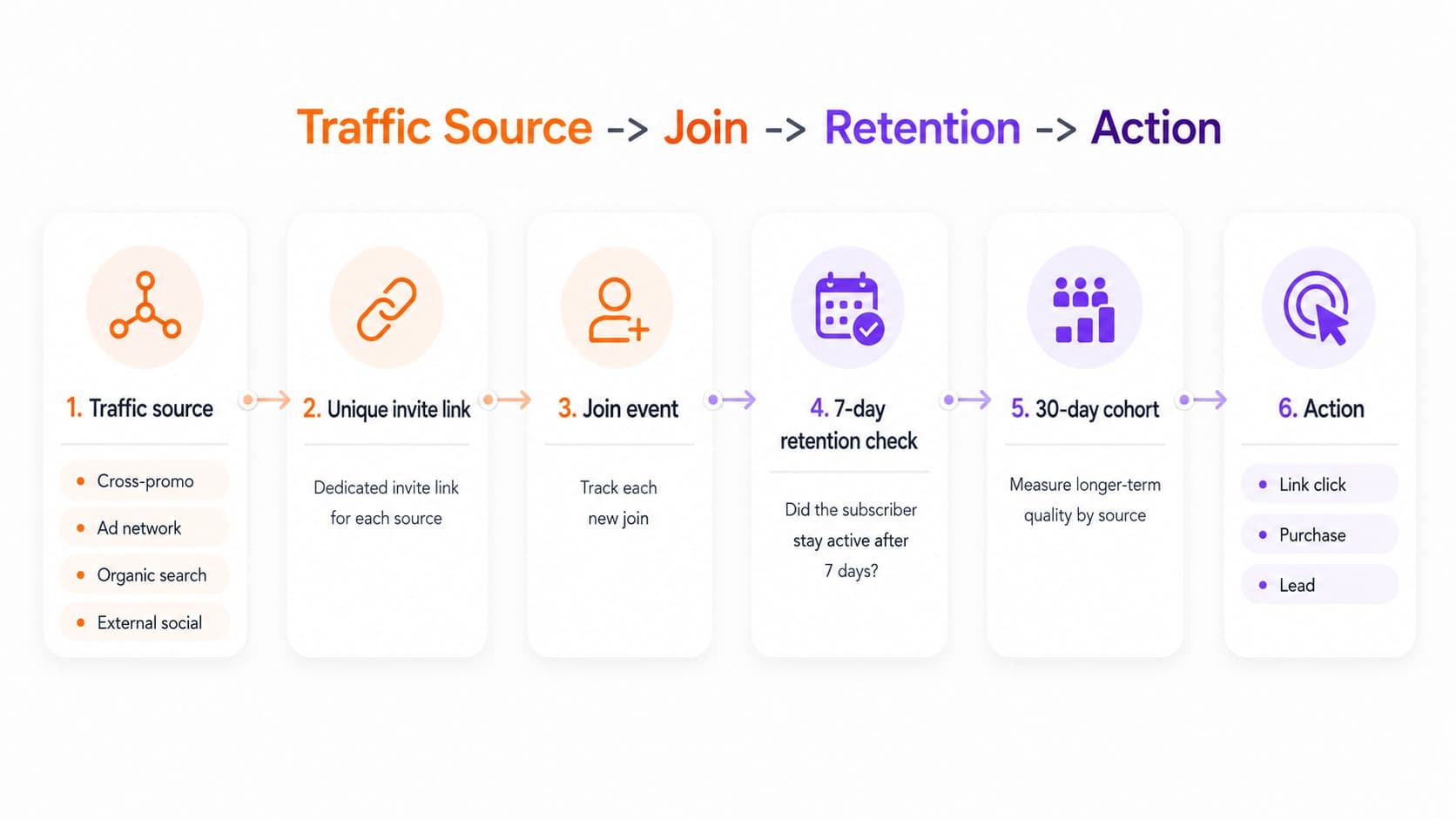
Attribution chain:
- Traffic source.
- Unique invite link.
- Join event.
- 7-day retention check.
- 30-day cohort review.
- Downstream action, such as click, purchase, demo request, or lead.
Common Telegram Promotion Mistakes to Avoid
Buying fake subscribers. Fake subscribers destroy your channel's usefulness as a marketing asset. When subscriber count is inflated with bots, view rate collapses. A channel with 10,000 subscribers and 200 views per post is not a strong channel. It is a weak channel with inflated numbers. You cannot measure ROI, attract serious cross-promo partners, or monetize effectively if the audience is fake.
Fake subscribers are also easy to spot for experienced marketers and channel owners. If you are building toward monetization or brand partnerships, fake subscribers actively work against you. Do not buy from any service that sells subscribers without explaining where the traffic comes from.
Spamming DMs and unrelated groups. Sending unsolicited DMs or posting channel links in unrelated groups is a fast way to get reported, muted, or banned.The alternative is value-first engagement: answer questions, contribute to discussions, and mention your channel only when it is contextually useful. It takes longer, but it produces subscribers who actually want to be there.
Scaling paid traffic before fixing retention. This is one of the most common and expensive mistakes. A team runs a paid campaign, subscriber count jumps, and then view rate drops sharply over the next two weeks. The problem is not always the campaign. Often, the welcome experience was unclear, the content cadence was inconsistent, or the ad promised something the channel did not deliver.
The fix is sequential:
- Optimize onboarding.
- Stabilize view rate.
- Test paid traffic.
- Measure retention.
- Scale only what works.
Inconsistent posting and no content system. Irregular posting trains your audience to stop checking. If you post three times one week and nothing for two weeks, view rate will reflect that.
Build a minimum viable content calendar:
- Define your posting days.
- Create 3-5 recurring formats.
- Keep a backlog of draft posts.
- Track which formats bring forwards and clicks.
- Avoid posting only when you feel inspired.
A consistent useful post is usually better than an occasional perfect post with long gaps between updates.
Pre-Flight Anti-Mistakes Checklist
Before serious promotion, check:
- Channel is public with a clean username.
- Bio answers who the channel is for, what it posts, how often, why to trust it, and what to do next.
- One CTA link is used in the bio.
- Welcome post is pinned and tested.
- Tracking links are set up per traffic source.
- No fake subscribers are purchased or planned.
- Content calendar exists.
- Cross-promo partners are vetted.
- Paid traffic is not running before a view-rate baseline is established.
- Directories are moderated and relevant.
- Giveaway prize, if used, matches the niche.
- Analytics tool is connected.
- Brand-safety exclusion list is defined before ad network campaigns.
Conclusion
The pattern that works across most niches is simple: optimize first, distribute second, pay third, measure always.
If you are a publisher starting from zero, fix your channel setup and welcome post before doing anything else. Then use free distribution: your existing network, cross-promotion, relevant directories, external platforms, and hashtags on your strongest posts. Once your view rate is stable, run a small paid test and measure whether those subscribers still read after 7 and 30 days.
If you are a brand, define what a quality subscriber means before buying traffic. Set up tracking links, prepare a clear welcome experience, run a controlled CPM test, and evaluate cohort retention before increasing budget.
Sustainable Telegram growth does not come from one tactic. It comes from matching the right audience with a channel that is genuinely worth reading.
For publishers - your next actions:
- Audit your channel setup today: bio, username, pinned post, and tracking links.
- Identify 3 channels for cross-promotion outreach and submit to several credible directories.
- Run one small paid test only after your organic view rate is stable, then measure 30-day retention before scaling.
For brands - your next actions:
- Define your ideal subscriber profile, build a brand-safety exclusion list, and set up unique tracking links per source.
- Evaluate 2-3 ad networks using the fraud-detection and transparency criteria above before committing a budget.