Finding a Telegram channel takes two minutes. Finding one that actually converts takes a system. This guide shows how to find public Telegram channels and groups, check whether they are worth advertising in, contact admins safely, run small test buys, and decide which placements deserve more budget. It focuses on public, accessible, and legitimate discovery methods - not scraping private communities, harvesting user data, bypassing invite-only access, or messaging users without consent.
A good Telegram buying process protects both the advertiser and the community. Advertisers need measurable placements, while channel owners need to keep user trust. If a channel hides ownership, refuses to share basic performance data, or asks you to skip required sponsorship disclosure, treat it as a risk signal.
Most failed Telegram ad buys start with a weak shortlist. A good shortlist should show niche fit, real views, admin reliability, and a clear test metric before money changes hands.
Sara Al MansooriAdTech Strategist at MangoAds.
The Fastest Way to Find Ad-Ready Telegram Communities
If you need a working shortlist today, use this four-step process. It is fast enough for a first campaign and structured enough to prevent the most common buying mistakes.
- Define niche, geography, and language before searching. Write down the topic your audience follows, the country or region you want to reach, and the primary language of your buyer.
- Use three discovery sources in parallel: Telegram in-app search, one public directory such as TGStat or Telemetr, and Google search operators (such as site:t.me "keyword") that surface public t.me pages, curated lists, forum mentions, and invite links related to your niche.
- Review each channel before contacting the admin. Look at average views, posting frequency, audience fit, recent growth patterns, and whether the content environment is brand-safe.
- Run a small test buy before scaling. Use one tracking link, one KPI, and a clear decision rule for whether the channel deserves more budget.
Telegram Advertising Cost
Telegram ad pricing is often negotiated directly with channel admins, so the same niche can have very different rates across regions, formats, and channel types. Use the ranges below as rough budget guidance, not as fixed market prices. Before planning your spend, confirm current rates using fresh quotes from channel admins, recent ad history, average views, and your own test results.
CPM only matters after you verify the audience. A low CPM in a weak channel can cost more in practice than a higher CPM in a channel where readers match your buyer profile.
Sara Al MansooriAdTech Strategist at MangoAds.
Always validate current pricing with fresh admin quotes, recent ad history, average views, and your own test results before using these numbers in a media plan.
| Niche | Typical CPM Range (USD) | Notes |
|---|---|---|
| Finance / crypto (Tier-1 geo) | $8-$25 | High intent; premium pricing. |
| Finance / crypto (MENA) | $4-$12 | Growing market; lower floor. |
| Tech / SaaS | $5-$15 | Varies by channel age and engagement rate. |
| E-commerce / retail | $3-$10 | High volume; test budget matters. |
| Health / wellness | $4-$12 | Brand safety check required. |
| News / general interest | $2-$7 | High reach, lower conversion intent. |
| Local / geo-targeted | $3-$9 | Depends on city-level demand. |
These ranges apply to direct channel placements in native post format. Telegram official ads use a separate TON-based model, and live requirements should be checked inside the current Telegram Ads interface before launch.
One key difference is where the ad can send users. Official Telegram Ads can promote a Telegram channel or bot, but they do not allow links to external websites. If you need to drive traffic to a landing page, checkout page, app store listing, or external form, a direct channel buy with a tracked link is usually easier to measure.
Official Telegram Ads vs Direct Channel Buys
Telegram has its own official advertising system, separate from direct outreach to channel admins. Official Telegram Ads are sponsored messages shown inside public Telegram channels with 1,000+ subscribers. The setup is more controlled: you create a short ad, choose where it can appear, manage budget inside the platform, and track results in the dashboard. Telegram describes this as a way to create sponsored messages in public one-to-many channels with at least 1,000 subscribers.
Official Telegram Ads work best when your goal is Telegram-native reach: growing a Telegram channel, sending users to a bot, or building awareness inside the Telegram ecosystem. They are less flexible if your campaign needs a long native post, a custom image or video, a pinned placement, or direct traffic to an external landing page.
Direct channel buys work differently. You contact the admin or media owner, agree on the format, placement time, price, disclosure, and reporting. This gives you more control over the creative: native post, image, video, pinned post, coupon, landing-page link, or bot start link. It also gives you more responsibility. You need to check the channel manually, confirm the admin identity, negotiate terms, prevent fraud, and measure results with your own tracking.
A simple rule: use Official Telegram Ads when you want a cleaner platform-based buying process and your destination is inside Telegram. Use direct channel buys when you need editorial-style placement, external tracking links, custom creative, or very specific niche channels that you want to select manually.
Telegram Channels vs Groups
Telegram channels and groups work differently for advertising, so you should evaluate them by different signals. A Telegram channel is a broadcast medium - the admin posts, subscribers read. A group is a conversation space - members post, reply, and shape the environment. The right choice depends on the campaign goal.
| Campaign situation | Better option | Why |
|---|---|---|
| You need predictable reach and clear post views | Channel | Channels show view counts, so it is easier to estimate CPM and compare placements. |
| You want clicks, joins, leads, or sales from a native ad post | Channel | A channel post is easier to track with one link, coupon, or bot start tag. |
| You want discussion, feedback, or trust around a complex offer | Group | Groups work better when people need to ask questions before converting. |
| You want an AMA, community partnership, or admin recommendation | Group | The placement depends on conversation quality, not only post views. |
| You need a first test with clean measurement | Channel | Channels are usually easier to evaluate before scaling. |
For most paid media campaigns, start with channels because they are easier to measure. Use groups when the offer benefits from discussion, peer recommendations, or community trust.
How to Evaluate a Telegram Group Before Advertising
Groups need a different quality check than channels. Do not judge them by member count alone. Look at daily active discussion, moderation quality, spam level, topic consistency, and whether admins allow commercial posts without annoying the community.
A group is worth testing when real members ask questions, share experience, and respond to recommendations. It is risky when most messages are links, bot replies, copied promotions, or unrelated discussions. Before paying, ask the admin what format is allowed: pinned post, admin recommendation, Q&A, giveaway, or partnership message.
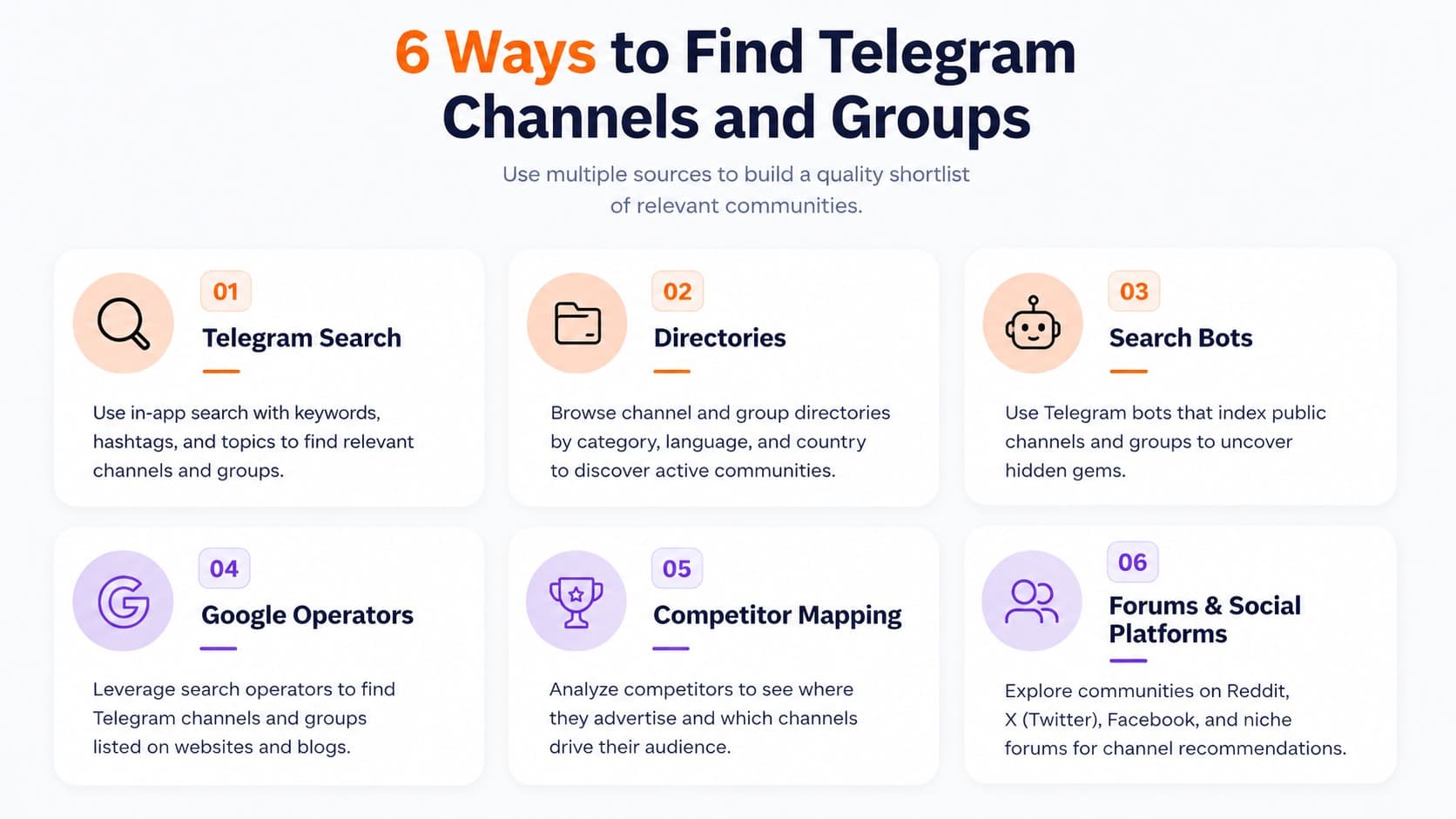
6 Ways to Find Telegram Channels and Groups
Method 1 - Telegram In-App Search
Telegram in-app search is the fastest starting point. It is free, requires no extra tool, and can surface public channels and groups in real time. The mistake is searching too broadly. Use query patterns that match how your audience describes the topic.
Start with the most obvious niche terms, then narrow the query by format, intent, geography, or language:
- For niche channels, search combinations such as crypto news, SaaS marketing, fashion deals, or startup updates.
- For local communities, combine the city or country with words such as chat, community, deals, events, or jobs. For example: Dubai chat, Berlin jobs, UAE crypto.
- For commercial audiences, add buying-intent words such as deals, offers, discounts, reviews, signals, or marketplace.
- For professional communities, try phrases such as fintech professionals, media buyers, founders, traders, or developers.
- For non-English campaigns, search in the target language first. Local-language keywords often reveal more relevant communities than English equivalents.
After each search, do not judge the result by the name alone. Open the channel or group, check the last 10-15 posts, look at posting frequency, average views, comments, and whether the audience matches your offer.
Method 2 - Public Directories and Catalogs
Directories are the most efficient tool for structured media buying. They aggregate subscriber counts, average views, engagement trends, posting history, and sometimes pricing into searchable databases. Use them for discovery, then verify manually before buying.
Start with one or two directories, such as TGStat or Telemetr, and filter channels by niche, language, geography, and category. Do not stop at subscriber count. Open each promising channel profile and check the signals that actually affect ad quality:
- Average views on recent posts, not only total subscribers.
- Engagement trend over time: stable, growing, declining, or suspiciously uneven.
- Posting frequency and whether the channel is still active.
- Ad history, especially how often sponsored posts appear.
- Category, language, and geo signals that match your campaign.
- Sudden growth spikes that do not match any visible viral post, mention, or cross-promo.
A directory is useful for building the first shortlist, but it should not make the final decision for you. After you find a promising channel, open it in Telegram and review the last 10-15 posts manually. Look at the content tone, ad density, comments, reactions, and whether recent views match the numbers shown in the directory.
If manual research becomes too slow, a vetted ad network can reduce the workload. For example, MangoAds can help with pre-checked Telegram channel inventory, verified views, CPM data, fraud signals, and campaign reporting. This is useful when you already understand your target niche but do not want to repeat discovery and admin checks for every placement.
For a comparison of leading platforms and features, see: 10 Best Telegram Advertising Networks
Method 3 - Telegram Search Bots
Telegram search bots can help you find channels and groups without leaving Telegram. They are useful when you want quick suggestions by keyword, category, language, or region. Some bots also show basic metrics, links to similar communities, or short descriptions of public channels.
Use them as a secondary discovery source, not as your main research tool. Bot databases may be incomplete, outdated, or biased toward channels that were submitted manually. A fast-growing channel may be missing, while an inactive channel can still appear in results.
The safest way to use search bots is simple: enter broad niche keywords, collect potentially relevant links, and then verify each result manually in Telegram and in a public directory such as TGStat or Telemetr.
Before using a bot, apply a few basic safety checks:
- Verify the bot username through an official website, trusted directory, or community recommendation.
- Never share your Telegram login code, password, recovery email, wallet seed phrase, or admin access.
- Avoid bots that ask you to sign in through an external page.
- Treat files, unknown links, and payment requests from bots as risk signals.
- Cross-check every promising channel before contacting the admin.
Search bots are best for expanding a shortlist, especially in niches where Telegram in-app search gives weak results. They are not enough for buying decisions.
Method 4 - Google Advanced Operators
Google can help you find Telegram communities that do not appear clearly in Telegram in-app search or public directories. It works especially well when a channel has a public t.me page, when invite links are mentioned on websites or forums, or when people discuss useful Telegram communities outside Telegram.
Advanced operators make the search more precise. Instead of typing a broad query such as best crypto Telegram channels, you can tell Google where to search and what exact words to look for.
- Use site:t.me when you want Google to show only public Telegram pages: site:t.me "crypto news"
- Use site:t.me/s when you want to search public web previews of Telegram channel posts: site:t.me/s "SaaS marketing"
- Use a niche plus a city or country when you need local communities: site:t.me "Dubai" "real estate"
- Use Google to find external mentions of Telegram links on forums, Reddit, blogs, or curated lists: site:reddit.com "t.me" "media buyers"
- Use broader queries when you want list articles or community recommendations: "best Telegram channels" "fintech", or "Telegram groups" "e-commerce" "t.me"
Google only helps you discover public links and mentions. After you find a promising channel or group, open it in Telegram and check recent posts, activity, average views, content quality, and admin contact details before adding it to your shortlist.
Method 5 - Competitor and Influencer Mapping
Competitor and influencer mapping takes more time than directory search, but it often produces a stronger shortlist. The logic is simple: if competitors, niche creators, or related brands appear in the same Telegram channels again and again, those channels may already have an audience that responds to similar offers.
Start by listing 5-10 competitors, partner brands, affiliate projects, influencers, or newsletters in your niche. Then look for where they are mentioned, forwarded, advertised, or discussed inside Telegram.
Track signals such as:
- Sponsored posts from competitors or similar brands.
- Repeated brand mentions in the same channel.
- Forwarded posts between related channels.
- Influencer posts that link to a Telegram channel or group.
- Channels where the same type of product appears more than once.
- Comments or reactions that show real interest, not just passive views.
Do not treat one competitor ad as proof that the channel works. A single placement may be a test, a barter deal, or a weak buy. A stronger signal is repetition: the same advertiser returns, several similar brands appear, or the channel is part of a visible niche cluster.
This method is especially useful in narrow niches where directories miss smaller communities. It also helps you understand the market: which offers are common, which creatives competitors use, how often channels publish ads, and which communities seem central to the niche.
Method 6 - Social Platforms and Forums
Social platforms and forums can reveal Telegram communities that are not easy to find through Telegram search or public directories. This is especially useful for smaller groups, local communities, niche professional chats, and high-intent audiences built around a specific problem.
The goal is not to scrape links, but to find public recommendations and community mentions. People often share Telegram links in Reddit threads, X posts, Facebook groups, niche forums, product communities, Discord discussions, newsletters, and comment sections. These mentions can lead you to channels and groups that are active but not listed clearly in directories.
Use search queries that combine your niche with Telegram-specific terms:
- site:reddit.com "Telegram group" "media buyers"
- site:facebook.com "Telegram group" "Dubai real estate"
- site:quora.com "Telegram channel" "SaaS founders"
- site:medium.com "t.me" "e-commerce community"
- site:producthunt.com "Telegram community" "startups"
When you find a link, check the context around it. A Telegram group recommended by several real users in a niche forum is usually a stronger signal than a random link dropped in a spam thread. Look for signs that people actually discuss the community, ask questions about it, recommend it, or refer to it more than once. Be careful with outdated or low-quality links. Some Telegram communities change names, become inactive, switch topics, or turn into spam channels.
Build a Repeatable Shortlist
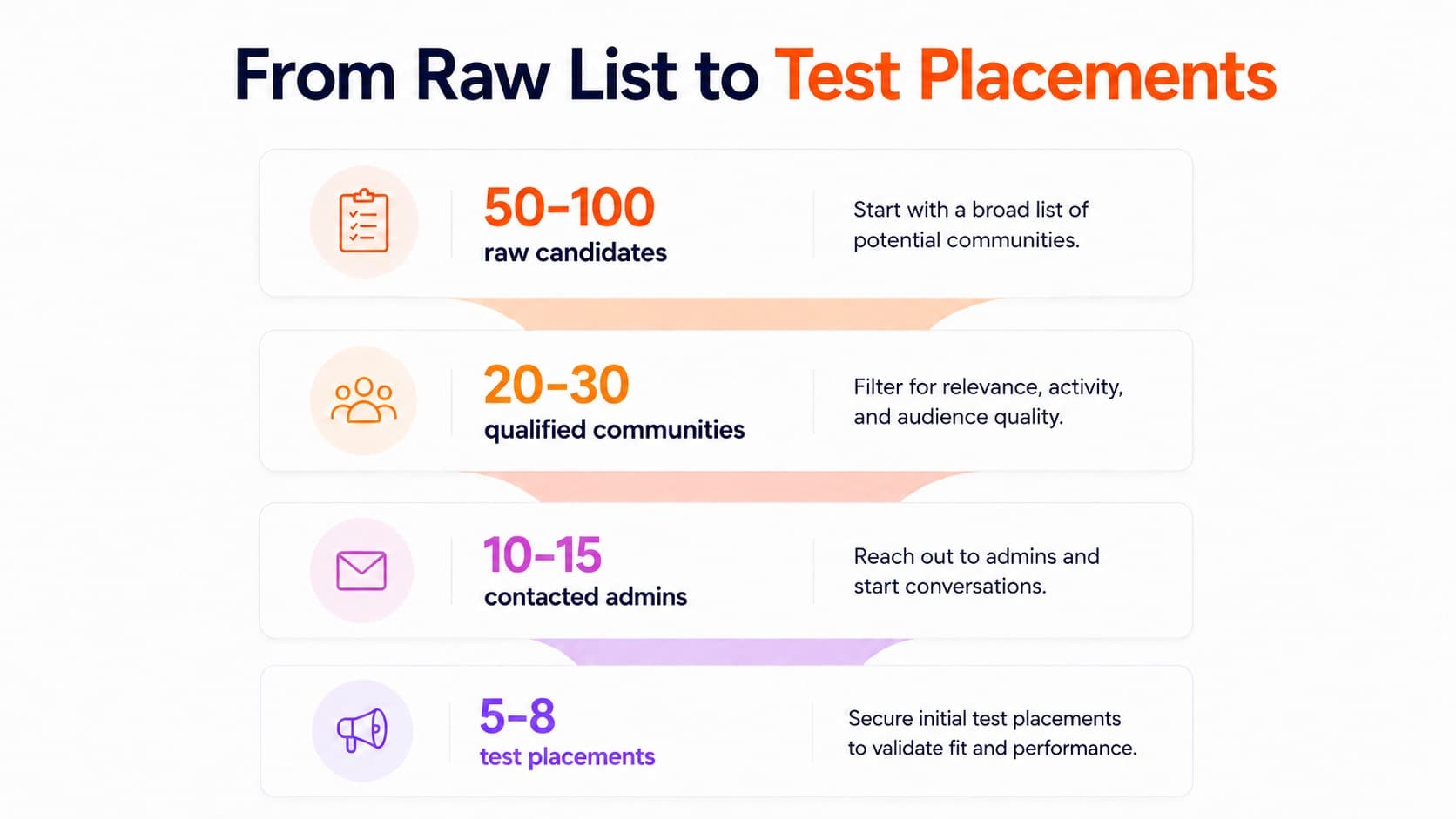
A shortlist is useful only if it helps you reject weak placements quickly. Do not collect Telegram channels just to have a long spreadsheet. Your goal is to move from a large raw list to a small group of channels or groups that are worth testing with money.
Start with 50-100 raw candidates from Telegram search, directories, Google, competitors, and forums. Then remove anything that fails basic checks: wrong language, wrong geography, inactive posting, unclear admin contact, very low recent views, unsafe content, or obvious spam.
After the first cleanup, score the remaining communities by five practical signals:
- Audience fit: the topic, language, geography, and buyer intent match your offer.
- Recent attention: posts still get stable views, comments, reactions, or real discussion.
- Ad quality: sponsored posts are not too frequent and do not dominate the feed.
- Admin reliability: contact details are clear, answers are professional, and terms are written down.
- Testability: the placement can be tracked with a unique link, coupon, bot start tag, or dedicated landing page.
For a first campaign, you do not need a perfect database. A simple shortlist is enough: channel link, average views from the last 10-15 posts, price, estimated CPM, audience notes, risk notes, admin contact, and test result. The most important field is the last one. After every placement, record whether the channel hit your KPI, missed it, or needs another test.
A practical funnel looks like this: collect 50-100 raw candidates, filter them down to 20-30 qualified communities, contact the best 10-15, and test the 5-8 that respond with clear terms and available slots. Over time, this shortlist becomes your own buying history, not just a list of Telegram links.
How to Evaluate a Telegram Channel or Group Before Buying Ads
Engagement Quality
Raw subscriber count is a weak buying signal. A channel with 100,000 subscribers and 2,000 average views can be worse than a channel with 10,000 subscribers and 3,500 average views. Always compare price against engaged attention, not audience size alone.
| Signal | Good Sign | Bad Sign | How to Verify |
|---|---|---|---|
| View-to-subscriber ratio | Recent views look stable and reasonable for the channel’s niche, geo, age, and posting format. | Very low recent views compared with subscriber count, especially on an older channel | Calculate manually from the last 10-15 posts. |
| Posting frequency | Consistent schedule. | Irregular bursts or no posts for 14+ days. | Scroll recent post history. |
| Reactions / comments | Varied, topic-relevant, natural. | Generic phrases from repeated no-photo accounts. | Sample 3-5 recent posts. |
| Forward activity | Present and proportional. | Disabled or zero on a channel claiming viral reach. | Check forward counts and repost patterns. |
| Content relevance | Consistent niche focus. | Mixed topics and off-category posts. | Read the last 20 posts. |
Audience Fit for Advertisers
A channel can have strong engagement and still be wrong for your offer. Audience fit is a separate check. Look at post language, posting times, product mentions, affiliate links, comment quality, and whether the content environment matches your brand guidelines.
| Criterion | 0 Points | 1 Point | 2 Points |
|---|---|---|---|
| Language match | No match. | Partial or mixed. | Full match. |
| Geo indicators | No regional signals. | Mentions target region occasionally. | Explicit target geo in posts or description. |
| Niche match | Unrelated category. | Adjacent niche. | Direct category match. |
| Commercial intent | No ads or anti-commercial tone. | Occasional promotions. | Regular commercial content and ad-friendly audience. |
| Brand safety | High-risk content. | Some borderline content. | Clean and brand-safe. |
Score interpretation: 8-10 points means strong fit, 5-7 means conditional fit, and below 5 usually means the placement should be skipped or reviewed later.
Fake Subscribers and Bot Activity
Bot inflation is one of the most common fraud patterns in Telegram advertising. Most fake growth leaves visible traces if you check recent posts and growth history before paying.
- Sudden subscriber spikes without a viral post, press mention, cross-promo, or other visible trigger.
- Large subscriber growth with flat or declining average views.
- Repeated generic comments from the same accounts across multiple posts.
- Subscriber counts that do not match directory data or recent post performance.
- A very low view-to-subscriber ratio on an older channel with no clear explanation.
The simplest fraud check is still manual sampling. Look at the last 10 to 15 posts, calculate average views, check comments, and compare growth spikes with real content events.
Sara Al MansooriAdTech Strategist at MangoAds.
Brand Safety and Compliance
Brand safety in Telegram is mostly manual. Before buying a placement, review the last 30-50 posts, pinned messages, comments if they are open, recent ads, and the admin’s behavior. The goal is to understand whether your brand can safely appear in this content environment.
Pay special attention to five risk areas:
- Content risk: politics, hate speech, adult content, gambling, illegal products, medical misinformation, financial promises, or aggressive clickbait.
- Comment risk: spam, scams, toxic replies, bot-like comments, or poor moderation.
- Ad risk: too many sponsored posts, low-quality advertisers, repeated casino or crypto offers, or ads that do not fit the channel’s stated topic.
- Claim risk: unrealistic promises, fake urgency, misleading investment claims, or unsupported health and finance advice.
- Disclosure risk: the admin refuses to label sponsored content when disclosure is required in your market.
A channel does not need to be perfect to be usable, but the risk should match your brand. A fintech, health, education, or B2B advertiser usually needs stricter checks than a low-risk entertainment campaign. If the channel’s recent content would be hard to explain to your client, legal team, or customers, skip it.
Outreach and Ad Buying
What to Ask the Admin
Use short outreach messages that ask for rates, average views, audience geography, available dates, ad formats, and disclosure rules. A professional admin should be able to answer these clearly.
Initial outreach template:
Hi, I am {name} from {brand}. We are looking to run a sponsored post in your channel for {offer category}. Could you share your rate card, average post views for the last 30 days, audience geo breakdown, available dates, and sponsorship disclosure rules?
Test buy template:
Hi {admin name}, we would like to run one test placement before committing to a larger campaign. Format: native post. Tracking: unique link. Budget: {amount}. If results meet our benchmark, we would like to discuss a monthly arrangement. Does this work for you?
Keep a written record of pricing, placement date, format, disclosure, report expectations, and payment terms. If disclosure is required in your market, do not ask an admin to skip it.
How to Negotiate Ad Rates
Many admins price placements by subscriber count. Buyers should reframe the discussion around expected views, effective CPM, and test results.
- Anchor to views, not subscribers. Calculate effective CPM from average post views.
- Start with one test placement before buying a package.
- Offer a recurring deal only after the first result meets your KPI.
- Use real competing quotes as leverage, but do not fabricate them.
- Ask about make-good or refund policy before payment, not after underperformance.
Test-Buy Framework
A test buy is a measurement exercise. The goal is not to run a perfect full campaign on the first attempt. The goal is to find out whether a channel can produce a result that is worth scaling.
Before you pay for a placement, choose one primary KPI. It can be CPC, cost per join, cost per lead, cost per install, or cost per purchase. Do not change the KPI after the campaign starts. If you judge one channel by clicks and another by leads, the results will be hard to compare.
Use a unique tracking setup for every placement. This can be a UTM link, a short tracking link, a coupon code, a dedicated landing page, or a bot start link with a source tag. Never use the same link across several channels in the first test, because you will not know which placement produced the result.
Keep the first test as clean as possible. Use the same offer and similar creative across several channels, especially if you are testing channel quality. If you change the offer, landing page, copy, and channel at the same time, you will not know what caused the result.
Wait for a reasonable signal before making a decision. Some Telegram placements produce most clicks in the first few hours, while leads or purchases may appear later. For most tests, review performance after 3-5 days or after the agreed reporting window. Do not scale a channel only because of early clicks if the final KPI is leads, installs, or sales.
After the test, record the result in your shortlist. Mark the channel as a winner, loser, or retest candidate. A winner meets your KPI and has acceptable traffic quality. A loser misses the benchmark or creates brand-safety, fraud, or admin reliability concerns. A retest candidate shows some promise but needs a different offer, timing, format, or price.
This approach keeps testing simple. You are not trying to prove that Telegram works in general. You are trying to identify which specific channels deserve more budget.
Tracking and Attribution Basics
Telegram post views are not clicks. Use click-based attribution whenever possible. Create a distinct tracking link for every placement so you can compare channels without ambiguity.
- Use UTM parameters or a URL shortener with click tracking for landing-page campaigns.
- Use unique coupon codes for e-commerce offers.
- Use dedicated landing pages when you want clean attribution by channel.
- Use bot start links with source tags when the conversion flow starts in Telegram.
- Report cost per event by dividing placement cost by clicks, joins, leads, installs, or purchases.
Choosing Your Path: Manual, Directories, Official Ads, or MangoAds
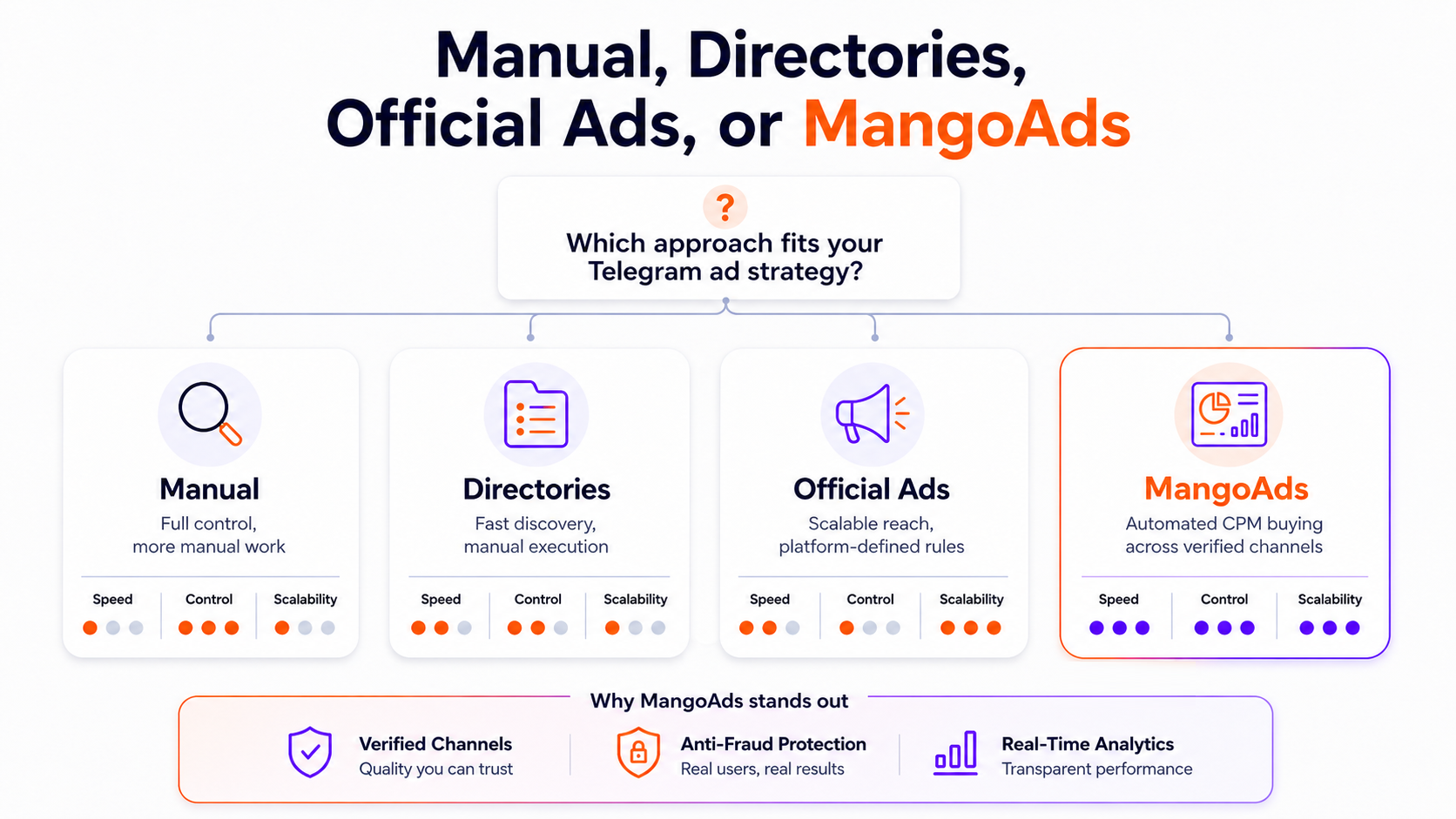
There is no single best way to buy Telegram ads. The right workflow depends on your budget, niche, team capacity, measurement needs, and how much manual risk you are willing to handle.
- Manual discovery works best when you are testing a narrow niche, exploring a new market, or trying to find smaller communities that do not appear clearly in directories. It gives you the most control, but it also takes the most time. You need to check views, content quality, admin identity, pricing, ad density, and tracking setup yourself.
- Public directories are useful when you need to build a shortlist faster. They help you compare channels by category, language, average views, posting history, and growth patterns. Directories are good for research, but they should not replace manual review. A channel can look strong in a database and still be a poor fit for your offer.
- Telegram Official Ads are better when you want platform-based reach inside Telegram and prefer a more controlled buying process. They are useful for awareness and Telegram-native growth, especially when your destination is a Telegram channel or bot. They are less flexible than direct buys if you need long native posts, custom creatives, pinned placements, or external landing-page tracking.
- MangoAds is more practical when you already know your target audience but do not want to repeat manual discovery, fraud checks, admin outreach, and reporting for every placement. A vetted network can help when you are running several placements per week, testing multiple niches, or need cleaner campaign reporting.
For a first campaign, a hybrid workflow usually works best: use Telegram search and directories to understand the market, test a few direct placements manually, and record the results. Once you know which niches, formats, and CPM levels work, move repeatable buying to a more structured process through official ads, a network, or a maintained internal shortlist.
The decision point is simple: if manual buying helps you learn, keep it. If manual buying slows down execution, reporting, or fraud control, switch to a more managed workflow.
Safety Checklist Before Contacting Telegram Admins
Advertisers are common targets for fake admins, phishing links, fake rate cards, and advance-payment traps. Keep the safety process simple and repeatable.
- Contact the admin only through the handle listed in the channel description or pinned post.
- Check the username character by character before sending payment.
- Ask the admin to confirm identity through a temporary post in the channel if the deal is new or high-value.
- Do not open unexpected files from unknown admins.
- Never share login codes, passwords, wallet seed phrases, or account recovery data.
- Start first-time buys with the smallest useful test budget.
- Keep written records of rate, format, date, disclosure, and payment terms.
Conclusion
The best Telegram ad placements are rarely found by browsing random channels. They come from a repeatable process: define your market, discover candidates from several sources, verify engagement and audience fit, contact admins professionally, run small tests, and scale only what proves itself.
Subscriber count should never be the deciding metric. The better question is whether a channel or group has real attention, a relevant audience, a safe content environment, and enough reliable data to justify a test. Once you record every result in a shortlist database, each campaign makes the next one faster and smarter.