"In eight years managing digital acquisition across MENA and Europe, I've seen marketers waste thousands chasing low CPM rates while ignoring the cost per actual result. Telegram is no different - focus on the effective cost, not the sticker price. The model you pick should match your creative quality and your funnel stage, not a generic best practice."
Sara Al MansooriAdTech Strategist at MangoAds.
Quick Answer: Decide Between CPC and CPM in 30 Seconds
Choose CPC if your goal is performance - bot starts, site clicks, app installs - and you need budget control while testing creatives. You pay only when a user acts, which protects limited budgets and isolates true cost per conversion.
Choose CPM if you have a proven high-CTR creative and need reach at scale for awareness or subscriber growth. CPM buys visibility; if your ad pulls strong engagement, impressions become cheaper per click than direct CPC bids.
Break-even rule of thumb
CPM becomes cheaper than CPC when your effective CPC - calculated as (CPM ÷ 1000) ÷ CTR - drops below your available CPC bid. If your creative hits 2% CTR on a €4 CPM campaign, your effective cost per click is €0.20. If the market CPC is €0.25, CPM wins.
Start CPC to learn CTR and CPA, then switch to CPM once CTR stabilizes high and frequency caps are in place. This progression lets you validate creative quality without gambling on impressions, then scale efficiently once you know what works.
Understanding CPC and CPM Models in Telegram Advertising
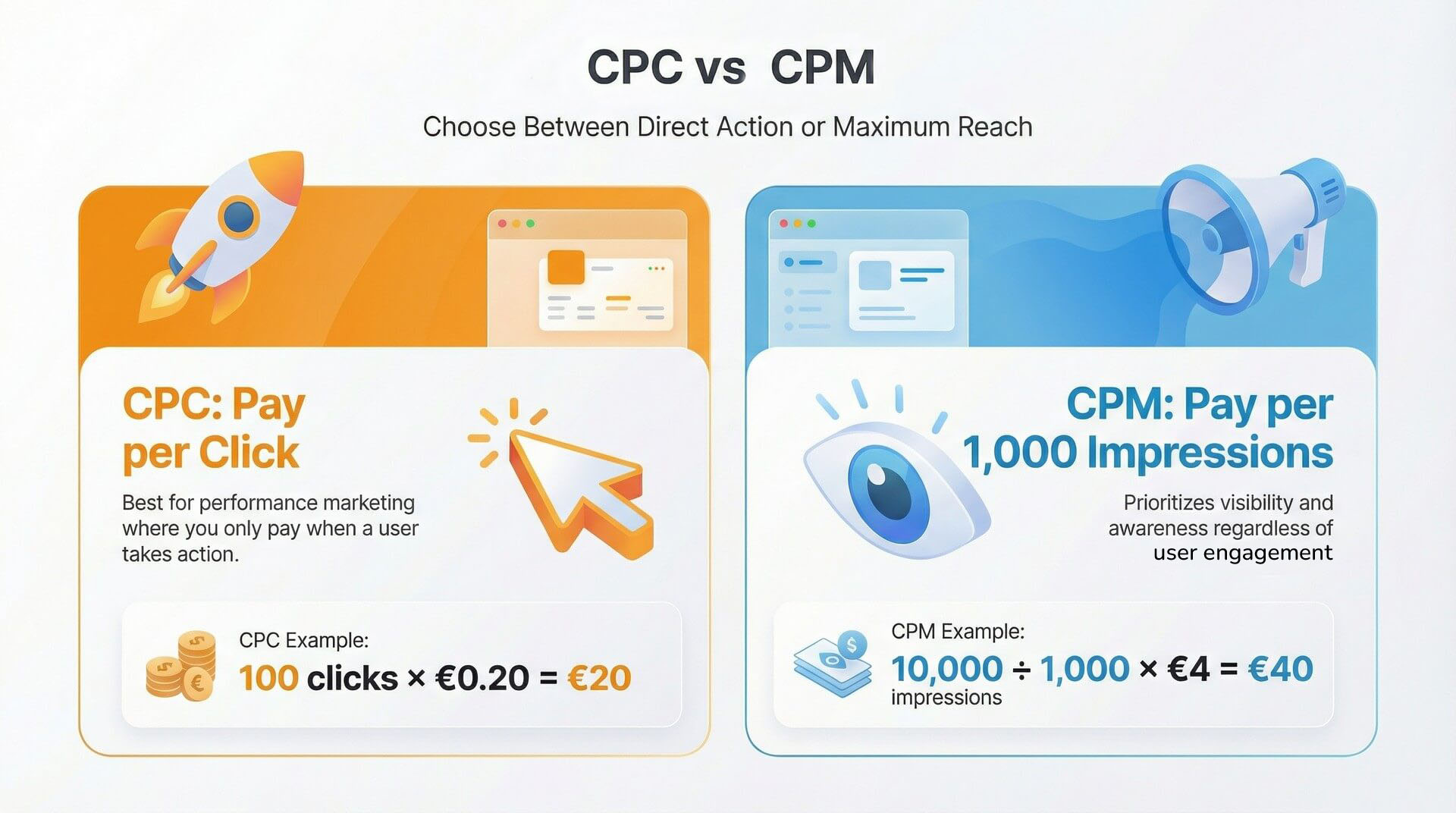
CPC (cost per click) and CPM (cost per mille, or cost per thousand impressions) are the two primary advertising models in Telegram advertising. With CPC, you pay only when a user clicks - ideal for performance marketing and direct response campaigns where every dollar must tie to an action. With CPM, you pay per 1,000 impressions, prioritizing reach and visibility regardless of whether users engage.
Telegram's advertising ecosystem supports both models, but availability depends on format. Official Telegram Ads - sponsored messages in public channels - run exclusively on CPM, with bids set in Telegram's native TON cryptocurrency.
"Official Telegram Ads have CPM as the only bidding model."
Sara Al MansooriAdTech Strategist at MangoAds.
Mini-App ads and third-party performance placements support CPC, letting advertisers pay per click or per specific action like a bot start or app open.
Understanding these advertising models helps you compare ad revenue potential versus spend. Impressions drive awareness (CPM logic), clicks drive actions (CPC logic). Your model choice affects how you manage budget, optimize creatives, and measure ROI from impressions and clicks.
Definitions:
- CPC = cost per click; you are billed each time a user taps your ad and lands on your destination.
- CPM = cost per mille (1,000 impressions); you are billed each time your ad is shown 1,000 times, regardless of clicks.
The gap between these models matters most when CTR varies. A high-CTR campaign on CPM delivers cheap clicks; a low-CTR campaign on CPM wastes impressions. Conversely, CPC isolates cost to actual engagement but can become expensive in competitive auctions where quality ads push bids higher.
“The minimum CPM for a sponsored message is 0.1 Toncoin.”
Telegram Ad Platform Explained, 2025
Official Telegram documentation confirms CPM as the default bidding model for sponsored messages, with minimum bids set at 0.1 TON (approximately $0.31–$0.36 USD as of late 2025, depending on exchange rates). Third-party platforms offering Mini-App inventory publish CPC options starting as low as $0.015 per click in lower-tier geographies.
Key Differences between CPC and CPM
If you need a fast comparison to match your goal, payment trigger, risk factor, and budget control, use the table below. This summary isolates the core trade-offs between brand awareness (CPM territory) and performance (CPC territory).
|
Dimension |
CPC |
CPM |
|
Payment trigger |
Pay per click |
Pay per 1,000 impressions |
|
Primary goal |
Performance, conversions |
Brand awareness, reach |
|
Risk factor |
Lower (pay for action) |
Higher (pay regardless of clicks) |
|
Budget control |
High (predictable CPA) |
Medium (requires CTR discipline) |
|
Works best when |
Limited budget, testing |
High CTR creatives, scale |
Why this matters
When you launch on a tight budget or test a new offer, CPC protects you from paying for wasted views. The platform bills you only after a user takes the action you defined - click, bot start, or external landing.
When you already know your creative performs - CTR proven at 2-3% or higher - CPM unlocks cheaper inventory. You pay a flat rate per thousand views, and if engagement stays high, your effective cost per click drops below what CPC auctions would charge.
The risk dimension flips based on creative quality. Low-engagement ads burn CPM budgets fast because you pay for impressions that never convert to clicks. High-engagement ads make CPM the smarter buy because every impression has a higher probability of turning into a measurable action.
Budget control under CPC is simpler: spend equals clicks multiplied by your bid. Under CPM, spend equals impressions divided by 1,000 and multiplied by your CPM - but if CTR collapses mid-campaign, you keep paying for views while results dry up. That's why CPM works best after you've stabilized CTR through CPC testing.
Break-even CTR and Effective Costs
The CTR Tipping Point (Break-even)
The formula that determines when to switch from CPC to CPM is straightforward:
eCPC from CPM = (CPM ÷ 1000) ÷ CTR
This tells you the effective cost per click if you buy impressions at a given CPM and achieve a specific click-through rate. If that effective CPC is lower than your current CPC bid, CPM wins.
Flip the formula to calculate effective CPM from a CPC campaign:
eCPM from CPC = CPC × CTR × 1000
Example: Your campaign runs at €4 CPM and pulls a 2% CTR.
eCPC = (4 ÷ 1000) ÷ 0.02 = €0.20 per click.
If the market CPC for your vertical and geography is €0.25, buying impressions at €4 CPM saves you €0.05 per click. Over 10,000 clicks, that's €500 in cost efficiency.
When to switch: If your observed CTR makes eCPC lower than your current CPC bid, move to CPM. If CTR is unstable or below break-even, stay on CPC until creative quality improves.
Creative Quality Drives Cost
Higher CTR from stronger creatives reduces eCPC (for CPM buys) and eCPM (for CPC buys), improving ROI in both directions. A 3% CTR creative at €4 CPM costs €0.13 per click; a 1% CTR creative at the same CPM costs €0.40 per click - triple the effective cost.
Invest in hooks, native formats, and audience-message fit to hit the tipping point sooner. The faster you stabilize CTR above break-even, the faster you unlock CPM's scale advantages without overpaying per result.
Extending to CPA and ROAS
To align bidding model to business outcomes, extend the math through to cost per acquisition and return on ad spend:
CPA from CPM = CPM ÷ 1000 ÷ (CTR × CVR)
CPA from CPC = CPC ÷ CVR
ROAS from CPM = (AOV × CVR × CTR × 1000) ÷ CPM
ROAS from CPC = (AOV × CVR) ÷ CPC
Worked example:
Your CPM campaign runs at €4, CTR 2%, CVR 5%, AOV €50.
eCPA = 4 ÷ 1000 ÷ (0.02 × 0.05) = €4 per acquisition.
eROAS = (50 × 0.05 × 0.02 × 1000) ÷ 4 = 12.5× return.
If your CPC bid is €0.25 and CVR stays 5%, CPA = 0.25 ÷ 0.05 = €5 per acquisition - CPM wins by €1 per conversion.
5-step How To Compute break-even CPM from your current CPC
- Pull your current CPC bid (e.g., €0.25).
- Pull your observed CTR (e.g., 2% = 0.02).
- Compute eCPM = CPC × CTR × 1000 = 0.25 × 0.02 × 1000 = €5.
- Compare to market CPM (e.g., €4 available).
- Decide: If market CPM < eCPM, switch to CPM; if market CPM > eCPM, stay on CPC.
Telegram Ad Formats and Pricing Models
Official Telegram Ads (Sponsored Messages) - CPM
Official Telegram Ads run as sponsored messages inserted into public channels with 1,000+ subscribers. The platform uses CPM-only bidding, auctioned by geography and topic targeting. Advertisers set a CPM bid in TON (Telegram's cryptocurrency), and the auction allocates impressions based on bid competitiveness and expected engagement.
Floor CPM varies by geo-tier. Industry reports from PropellerAds and CIPIAI (2025) document minimum bids around 0.1 TON (~$0.36–$0.50 USD), but competitive auctions in Tier 1 countries (US, UK, Germany) push effective CPM higher.
"USA, UK, Germany and France often command CPMs of $10–$12.
Eastern Europe and parts of MENA typically see CPMs around $3–$5.
Uzbekistan, India and many LATAM countries show CPMs around $0.30–$0.60.
"
Telegram's auction logic adjusts bids by expected CTR - ads with higher historical or predicted engagement win slots at lower nominal CPM because the platform earns more per impression when CTR rises. This means creative quality directly impacts your cost, even in a pure CPM model.
Billing mechanics
Impressions are counted when ads appear in a user's channel feed. Daily budgets and pacing apply.
Pacing, Floors, and Frequency Control
Daily minimums and pacing rules prevent budget spikes. Frequency caps are typically set at 1–2 ads per user per day to avoid ad fatigue, which collapses CTR and raises effective cost per result.
"Floor prices and frequency caps are where most marketers lose control. If you don't set a frequency cap, the platform will keep showing your ad to the same users until CTR collapses - then your effective CPM triples. Pacing and caps are not optional; they're cost-protection tools."
Sara Al MansooriAdTech Strategist at MangoAds.
Telegram Mini-App Ads - CPC
Mini-App ads target users inside Telegram's bot ecosystem and mini-applications. These placements support CPC bidding, where advertisers pay per click or specific action (bot start, app open). Formats include push-style notifications, interstitial ads, and embedded banners.
According to RichAds and PropellerAds industry data (2025), CPC rates vary by geography and vertical. US placements range $0.05–$0.081; India and Indonesia drop to $0.012–$0.013. High-intent verticals (crypto, trading, finance) push CPC higher; low-margin categories (entertainment, lifestyle) stay near the floor.
Mini-App CPC is a strong fit for testing funnels and creatives before scaling to CPM. You pay only for engaged users, isolating cost per action and protecting budget while you learn what hooks work.
Mini-App format pricing:
|
Mini‑App format |
Model |
Floor |
|
Push‑style |
CPC |
$0.015 |
|
Interstitial banner |
CPM |
from $1.5 |
|
Embedded banner |
CPM |
from $0.4 |
|
Interstitial video |
CPM |
from $3 |
|
Ads in bots |
CPM |
from $3.8 |
|
Playable (HTML5) |
CPM |
from $3 |
Sponsored Posts in Channels - Hybrid
Ad seeding refers to direct or network-mediated placement of promotional posts inside Telegram channels. Pricing is typically negotiated as a fixed price per post or sold in packages. Advertisers calculate back to CPM or CPC for comparability by dividing total cost by impressions or clicks delivered.
"Use CPM = Total Impressions ÷ Total Cost × 1000."
Sara Al MansooriAdTech Strategist at MangoAds.
Buy via telegram ad networks (such as MangoAds, RichAds, AdsGram, PropellerAds) for scale, moderation, and standardized workflows. These platforms aggregate Telegram channels, enforce content policies, and reduce manual coordination.
Buy via direct deals with channel owners for niche relevance and custom creative integration.
Industry benchmarks from PropellerAds cite CPM ranges for ad seeding in CIS countries by topic: Memes €1.50–€2, Finance €20+, IT €10, News €2.50–€3. These rates reflect audience quality, niche competitiveness, and channel reputation.
For channel owners looking at the same ecosystem from the supply side, MangoAds breaks down pricing models, CPM benchmarks, and monetization strategies in a separate guide "Telegram channel monetization guide".
When to Choose CPC for Your Campaign
Choose CPC when you need performance marketing efficiency and granular budget control. CPC is optimal for direct response with a conversion focus, especially while you're testing creatives to discover a high click-through rate. CPC isolates the cost per action, protecting limited budgets and maximizing ROI before you commit to scale.
Launch or iterate unproven creatives. Measure click-through rate and conversion rate without overspending. If a headline or visual fails to pull clicks, you stop paying immediately. CPC turns creative testing into a low-risk, data-driven loop.
Early-stage funnels or new offers with limited budget. Pay only for clicks to contain risk. If your total budget is $500 and you're validating product-market fit, CPC ensures every dollar goes to users who took the first step in your funnel.
Performance marketing sprints. Direct response goals like bot starts, app opens, or website visits align naturally with CPC. The billing event matches the campaign objective - click equals entry into the funnel.
High CTR uncertainty. If you don't yet know whether your creative will pull 0.5% or 5% engagement, CPC keeps spend efficient until CTR stabilizes. Once you hit consistent performance, you can calculate break-even and consider switching to CPM for scale.
Rapid testing velocity. Swap hooks, visuals, and CTAs to push CTR up and learn fast. CPC rewards quality immediately - better ads cost less per result because auction algorithms favor high-engagement creatives.
CPC protects you when the campaign goal is measurable action and the creative is unvalidated. Once both stabilize - goal clarity plus proven CTR - CPM becomes the path to scale.
When to Choose CPM for Your Campaign
Choose CPM when your ads already show high-performing CTR and you want scale and reach. CPM is best for brand awareness, visibility, and maximum exposure, especially when your established CTR makes impressions cheaper than paying per click. With strong creatives, CPM delivers low effective CPC at scale and predictable reach.
Scaling a proven creative. Established CTR indicates impressions will convert to clicks efficiently. If your CPC testing phase shows 2–3% CTR, switching to CPM at a competitive rate locks in cheaper clicks and opens inventory you couldn't access under CPC caps.
Brand awareness and subscriber pushes. Prioritize reach and visibility across large audiences. CPM buys eyeballs; if your goal is top-of-funnel recognition or channel growth, impressions matter more than immediate conversions.
Large audience availability. You need to cap frequency and maximize exposure in short windows - product launches, event promotions, seasonal campaigns. CPM lets you flood the market with impressions, then refine targeting based on engagement data.
Retargeting warm users. High expected engagement reduces risk. If you're retargeting users who already interacted with your brand, CPM becomes safer because CTR will likely stay elevated, keeping effective CPC low.
Negotiating premium placements. CPM unlocks predictable delivery and control over reach. Some high-value channels or exclusive placements only sell on CPM terms; if you want guaranteed visibility in a specific community, CPM is often the only option.
CPM shifts the risk from the platform to you - if CTR collapses, you keep paying. That's why CPM is the reward for creative validation, not the starting point. Prove engagement first; scale with impressions second.
Current Market Indicative Benchmarks and Ranges
|
Geography/Tier |
CPM Range (USD) |
CPC Range (USD) |
Notes |
|
Tier 1 (US, UK, DE, FR) |
$10–$12 (competitive niches) |
$0.05–$0.25+ |
High competition; quality audiences |
|
Tier 2 (CEE, LATAM major, MENA) |
$3–$5 |
$0.02–$0.10 |
Balanced cost/reach; growing markets |
|
Tier 3 (Emerging: IN, UZ, smaller LATAM/Africa) |
$0.30–$0.60 |
$0.008–$0.02 |
Volume plays; lower ARPU |
|
Niche: Finance/Crypto (all tiers) |
×1.5–×3 baseline |
$0.20–$0.80+ |
High LTV; intense auction pressure |
|
Niche: Tech/Gadgets (all tiers) |
×1.2–×1.8 baseline |
$0.03–$0.15 |
Moderate competition; educated buyers |
Information is general and does not replace professional advice. Verify budgets and bids against live auctions.
Disclaimer
Benchmarks compiled from agency logs and public case studies. Always verify with live auctions. Telegram's auction dynamics shift as advertiser demand grows and the platform adjusts floor prices. Treat these ranges as starting points for budget planning, not guarantees.
Optimizing Your Costs
Creative and CTR Optimization
Lead with native angles, clear value, and strong CTA. Telegram users scroll fast; your first 90 characters and thumb-stopping visual determine whether they engage.
Test headlines and CTAs weekly. A/B test different value props, urgency hooks, and CTA wording. Rotate creatives to avoid ad fatigue - frequency caps help, but fresh creative prevents CTR decay.
Targeting and Inventory
Identify undervalued audiences and channels. Expand lookalikes based on high-performing segments. Use topic and geo combinations with favorable CPM floors - Tier 2 and Tier 3 geographies offer 5–20x cost savings versus Tier 1 while still delivering qualified traffic.
Experimentation Cadence
Run continuous creative tests. Swap headlines, visuals, and copy every 5–7 days. Track CTR and CPA by variant; kill underperformers at 1.5× target CPA.
Use MangoAds creative insights (if available) to rank hooks by predicted engagement before launching.
Delivery Controls
Daypart based on peak engagement. Schedule ads during hours when your audience is active. Adjust delivery windows to match local time zones.
Set frequency caps to protect CTR. Limit ad repetition to 1–2 per user per day. Overexposure kills engagement and raises effective CPM/CPC.
Integrity
Mitigate click fraud in CPC campaigns. Whitelist reputable channels for ad seeding. Use third-party fraud detection if running high-volume CPC.
Monitor click-to-conversion rates. Sudden spikes in clicks without conversions signal bot traffic or low-quality inventory; blacklist those placements immediately.
|
Lever |
Expected Impact |
Priority |
|
Headline + CTA testing |
Improves CTR |
High |
|
Geo-tier targeting (Tier 2/3 vs Tier 1) |
5–20× cost reduction (CPM/CPC) |
High |
|
Frequency cap enforcement |
Prevents CTR decay |
High |
|
Dayparting (peak hours) |
Engagement lift |
Medium |
|
Channel quality whitelisting (fraud mitigation) |
CPA improvement |
Medium |
Mini triage checklist for when CTR drops mid-flight:
- Reduce frequency cap (from 2/day to 1/day).
- Rotate creatives (swap headline/visual).
- Tighten topic targeting (remove broad categories).
- Pause underperforming geos (check CTR by country).
- Review bid vs floor (raise if delivery stalled).
Common Mistakes Advertisers Make
Ignoring floor CPMs and quality adjustments in the official ads auction. Telegram's auction favors high-CTR ads with lower bids over low-engagement ads with higher bids. If your creative underperforms, raising your CPM bid won't fix delivery - improve the creative.
Chasing low CPM while sacrificing conversion rate and ROI. A $0.50 CPM campaign with 0.1% CTR costs $0.50 per click. A $4 CPM campaign with 2% CTR costs $0.20 per click. Focus on effective cost, not sticker price.
Misjudging geo/niche price differences; not recalibrating bids. Tier 1 CPM is 10–40× higher than Tier 3, but conversion rates may differ by only 2–3×. Always calculate ROAS by geography and reallocate budget toward higher-efficiency tiers.
Undertracking sponsored posts; no UTM or post-click analytics. If you buy ad seeding without UTM parameters or click tracking, you can't measure CPC, CPA, or ROI. Add tracking to every placement, regardless of pricing model.