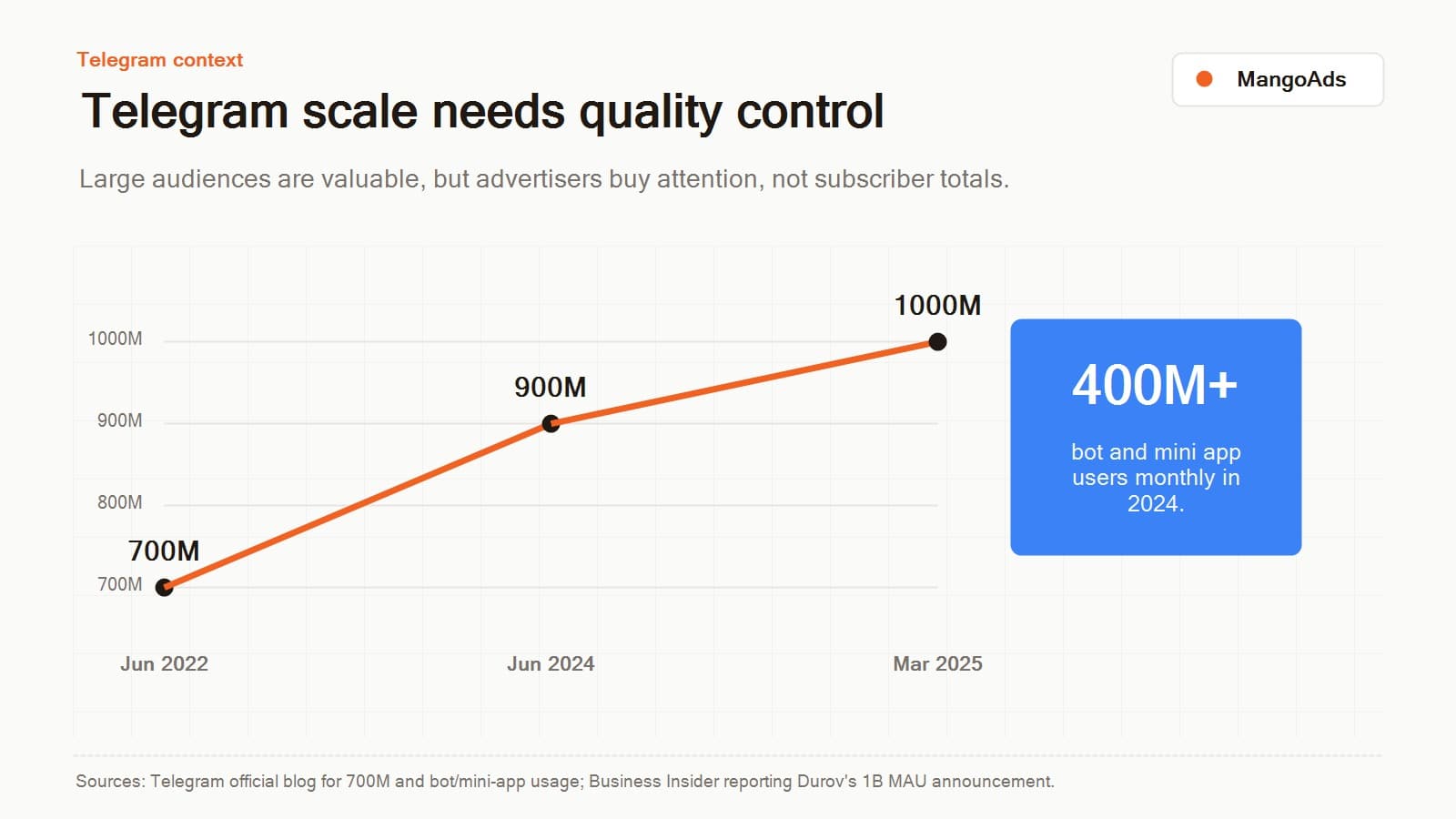
Telegram ad placements can bring qualified traffic, brand awareness, community growth, and sales. The catch is that the public numbers only matter when there is a real audience behind them.
On the surface, a channel can look like an easy yes: 80,000 subscribers, thousands of views per post, active reactions, polished content, and an admin who sounds confident. Then the ad goes live and the campaign is quiet. No clicks. No leads. No sales. No useful engagement.
That is the trap: the numbers were visible, but the attention behind them was not useful.
This is the risk behind manual Telegram media buying. Some channels inflate subscribers, views, reactions, or comments. Others are not fake in the strict sense, but their audience is inactive, irrelevant, overexposed to ads, or simply unlikely to act.
If you use an automated Telegram advertising platform, this screening happens before a channel becomes available to advertisers. MangoAds checks channel quality and does not connect low-quality Telegram channels to the platform. The checks below are still useful: they help you understand what good inventory looks like and how to read campaign results with a sharper eye.
If you are still building your channel list, start with our guide on how to find Telegram channels and groups for advertising, then use this article as the quality-control layer before you spend.
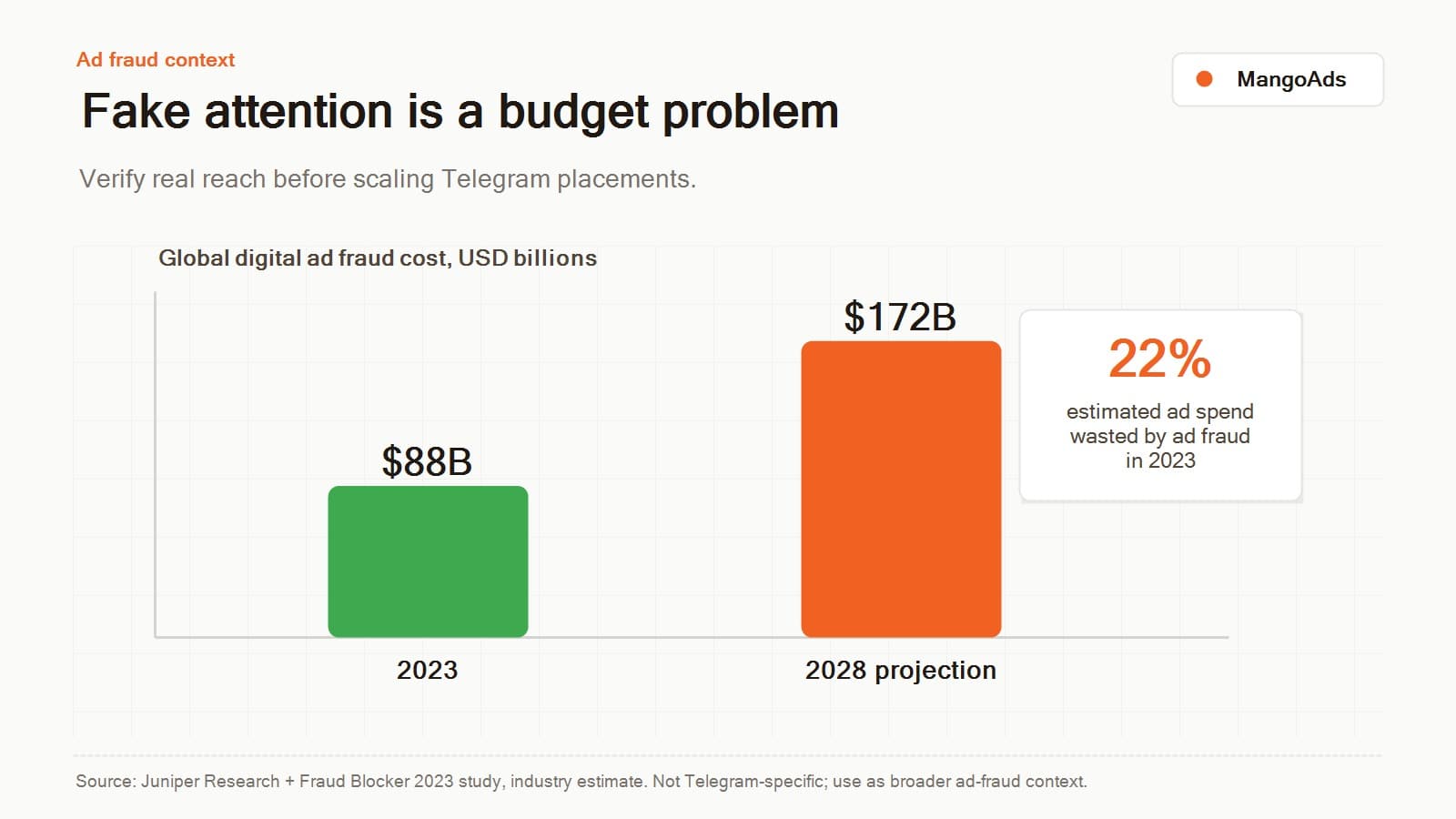
What Is a Fake Telegram Channel?
In advertising, a fake Telegram channel is not always a channel with zero real people. The risk is broader.
A channel becomes a bad ad placement when its public metrics exaggerate the amount of real, reachable, relevant attention you can actually buy.
Common problems include:
- bought subscribers who never read posts;
- bot-generated views that inflate reach;
- artificial reactions or comments;
- copied content used to make a channel look active;
- channels that were renamed or repurposed after growing in another niche;
- real subscribers, but weak trust, low engagement, or too many ads.
For advertisers, the practical question is not "Are all subscribers fake?" It is "Can this channel produce real attention from the audience I want to reach?"
That distinction matters. A channel can have real subscribers and still be a poor buy if the audience is wrong for your offer. Another channel may have one unusual metric and still deserve a small, tracked test if the audience fit is strong.
Quick Telegram Channel Quality Checklist
Before paying for a Telegram ad placement, check these signals:
| Signal | Healthy pattern | Warning sign |
|---|---|---|
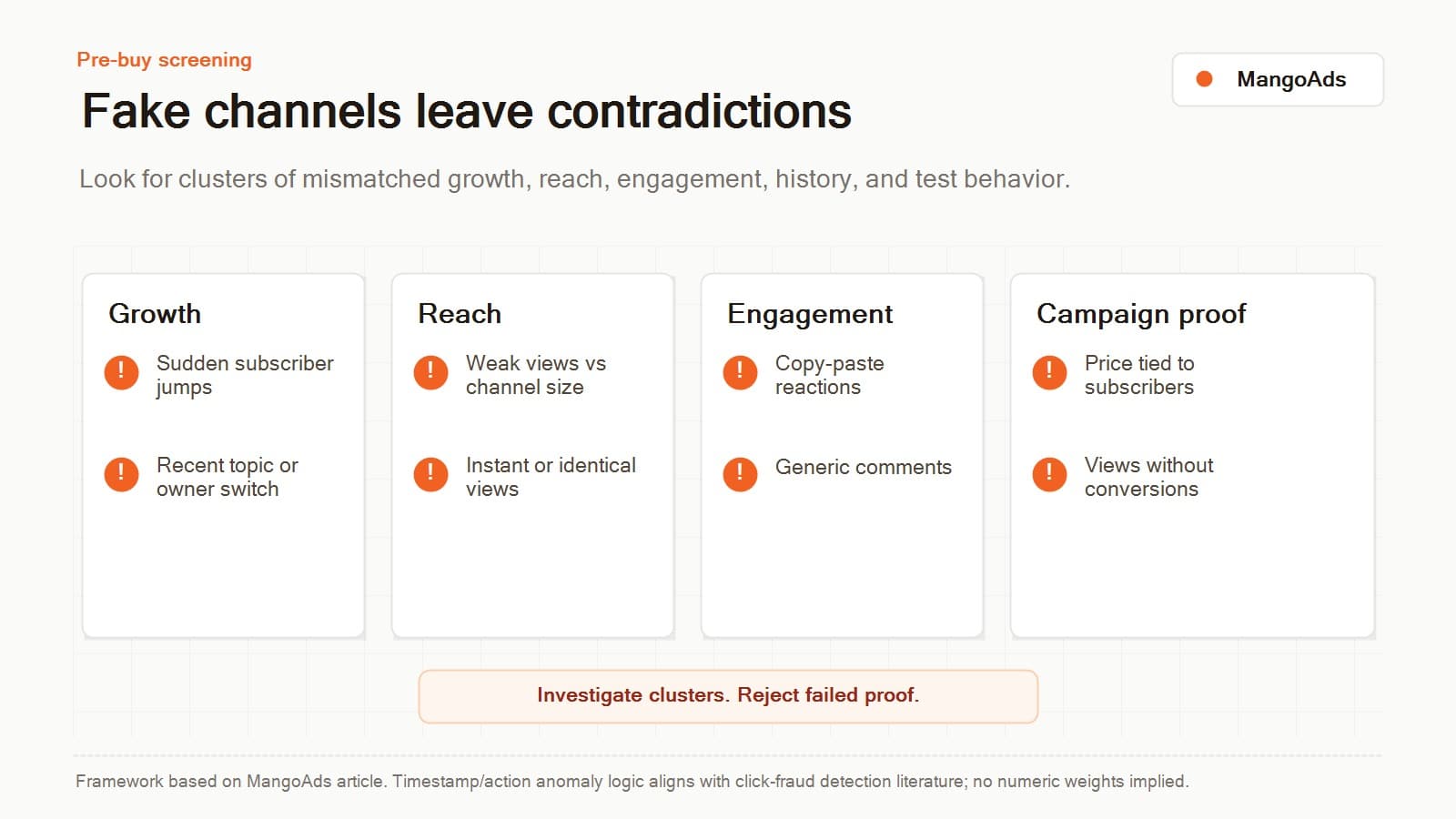
| Subscriber growth | Gradual growth with explainable spikes. | Sudden jumps without visible content, mentions, or campaigns. |
| Views per post | Stable range that fits the channel's size. | Identical view counts, instant spikes, or consistently very low reach. |
| View rate | Reasonable for the niche and channel size. | A large subscriber count with very low post reach. |
| Reactions | Varied and proportional to the number of views. | The same reactions on every post or an unusually high reaction volume. |
| Comments | Specific discussions from real users. | Generic comments, repeated phrases, or unrelated replies. |
| Content history | Consistent topic, language, and audience. | Recent topic changes, deleted history, or copied posts. |
| Ad history | Relevant sponsored posts published at a reasonable frequency. | Too many ads, spammy offers, or low-quality advertising categories. |
| Pricing | Based on expected reach and niche quality. | Based mainly on subscriber count. |
| Admin behavior | Clear terms, examples, and performance statistics. | Pressure tactics, vague answers, or no tracking options. |
| Test results | Clicks and conversions match expectations. | Views generate little or no meaningful downstream activity. |
One weak signal is not a verdict. News channels can spike. Large entertainment channels can have lower engagement than small expert communities. What matters is whether the signals fit together or start contradicting each other.
Tools and Data Points to Use
You can catch obvious problems inside Telegram itself. For a serious buy, combine that first look with analytics tools and your own tracking.
Useful data sources include:
- Telegram's visible channel history, post views, reactions, comments, and forwards;
- Telegram's built-in statistics, if you own or manage the channel;
- third-party Telegram analytics tools such as TGStat, Telemetr, Popsters, LiveDune, or similar services;
- screenshots from the channel admin, used only as supporting evidence;
- your own campaign tracking: UTM links, short links, promo codes, bot starts, CRM data, and landing page analytics.
If you are new to these metrics, read our guides to Telegram analytics tools and how to read Telegram statistics.
For ad buying, the key is not to find one magic number. It is to compare several signals and see whether they tell the same story.
What to Check in TGStat, Telemetr, or Similar Tools
When you use tools like TGStat, Telemetr, Popsters, or LiveDune, do not stop at the channel’s subscriber count. Start with the subscriber chart. Look for sudden jumps, repeated growth spikes, or long flat periods followed by a sharp increase. Then compare those changes with the channel history: reposts, mentions from larger channels, viral posts, paid promotion, or topic changes. If the audience grew fast but there is no visible reason, treat it as a warning sign.
Next, check post reach dynamics. Look at recent organic posts, older posts, and sponsored posts if you can find them. A healthy channel usually has some variation: stronger posts get more reach, weaker posts get less, and sponsored posts may perform slightly differently. Be careful if every post gets almost the same number of views, if views appear too quickly, or if ad posts perform much worse than normal content.
Finally, compare ERR, VRpost, reactions, comments, forwards, and mentions together. A channel can have a decent view rate but weak human signals. For example, strong views with almost no comments, no forwards, repetitive reactions, and no meaningful mentions may point to low-quality attention. You should also check channel history for renames, deleted content, topic switches, and old ads. Those details often explain why a channel looks good in a directory but performs badly in a campaign.
How to Detect a Fake Telegram Channel
A reliable check should combine audience growth, post views, engagement patterns, content history, and previous ad results. No single metric can prove that a channel is fake, so evaluate several signals together before paying for a placement.
1. Check Subscriber Growth over Time
Fake or low-quality channels often have unnatural growth patterns.
Do not judge a channel only by its current subscriber count. Look at how the audience grew. Use Telegram analytics tools, public directories, historical snapshots, or any available channel statistics to understand the growth curve.
Healthy growth usually has a story:
- steady growth from regular publishing;
- spikes after viral posts;
- growth after reposts from larger channels;
- paid promotion that matches the channel topic;
- seasonal growth that makes sense for the niche.
Suspicious growth often looks different:
- thousands of new subscribers in one day with no clear reason;
- repeated spikes followed by slow decline;
- subscriber growth that does not improve views or engagement;
- long inactive periods followed by sudden audience jumps;
- a channel that changed topic after building its audience elsewhere.
If a channel has 100,000 subscribers but recent posts get only 1,000 to 2,000 views, the subscriber count may not matter much. You are buying attention, not a decorative audience number.
2. Compare Subscribers, Views, ERR, and View Rate
Subscriber count is the first number most buyers notice. It is also the easiest number to overvalue.
A more useful metric is view rate, sometimes also called VRpost: View rate = average post views / subscribers x 100
For example, if a channel has 50,000 subscribers and recent posts get around 10,000 views, the view rate is 20%.
You can also calculate a practical engagement rate by comparing reactions, comments, or forwards with views: Reaction rate = average reactions / average post views x 100
This is not the same as purchase intent, but it helps you see whether views are connected to human behavior. A channel with high views and almost no reactions, comments, or forwards deserves closer inspection.
There is no universal "good" view rate or engagement rate for every Telegram channel. It depends on the niche, country, language, channel size, posting frequency, content type, and audience behavior. Smaller expert channels can have very high view rates. Large entertainment or news channels may have lower view rates but still deliver useful scale.
The better question is whether the numbers behave like a real audience.
Red flags include:
- very low views compared with subscriber count;
- almost identical views on every post;
- views that appear immediately after posting and then stop;
- sponsored posts getting much lower reach than organic posts;
- high views that produce no clicks, visits, or conversions.
Check at least the last 20 to 30 posts when possible. A channel can show a strong screenshot or pin a high-performing post, but a longer sample reveals the real pattern.
Do not turn one benchmark into a hard pass/fail rule. Use metrics as prompts for better questions: Why is reach low? Why did subscribers jump? Why do views look strong while comments are empty? A real channel should usually have a plausible answer.
Sara Al MansooriAdTech Strategist at MangoAds.
3. Watch for Mechanical View Spikes
Real Telegram views usually accumulate over time. The curve depends on the channel, but you often see fast early views from active subscribers, then slower additional views over the next several hours or days.
Suspicious channels may show more mechanical behavior:
- a post gets thousands of views within minutes, then almost no growth;
- every post reaches a similar number of views regardless of topic;
- ad posts receive the same view pattern as strong organic posts;
- views look impressive, but reactions and comments are nearly absent.
Instant views do not prove fraud by themselves. Some channels have active audiences and strong notification behavior. But if instant views appear together with weak engagement, odd growth, and poor campaign results, treat it as a serious warning sign.
Bot Traffic Patterns to Watch For
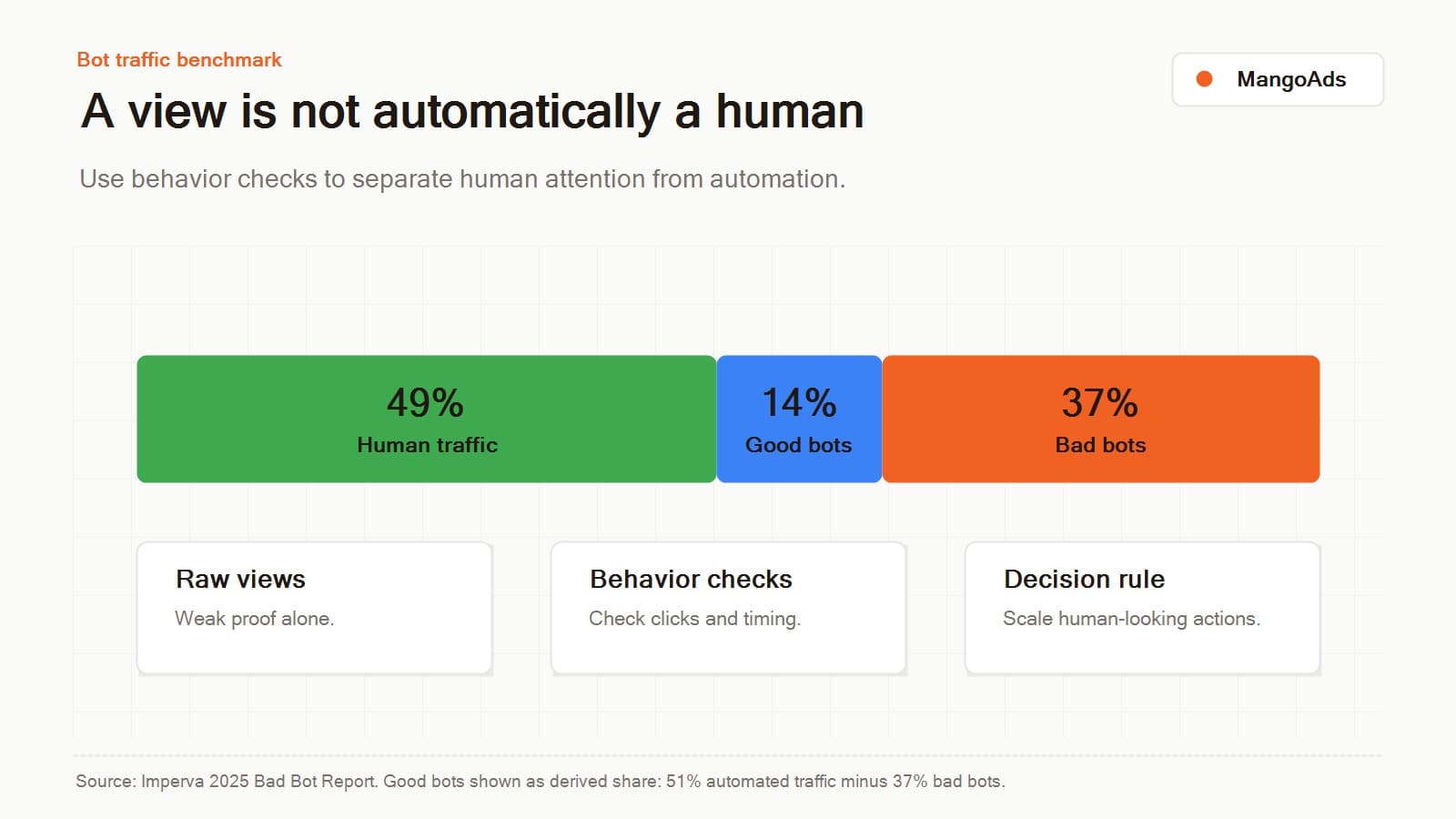
Bot traffic rarely looks like one single obvious signal. More often, it shows up as a pattern of numbers that do not behave like a real audience.
Be careful when a channel has fast view spikes but almost no reactions, comments, forwards, or clicks. Another warning sign is identical behavior across many posts: similar view counts, similar reaction volume, and the same engagement pattern regardless of topic, timing, or post quality.
Also look at what happens after the click. If a campaign gets many bot starts, landing page visits, or short-link clicks but almost no real conversation, signup quality, scroll depth, or conversion activity, the problem may not be the creative. The traffic itself may be low-quality or automated.
Bot patterns are easier to spot when you compare several signals together:
- views arrive too quickly and then stop;
- views are high, but comments and reactions are thin;
- reactions repeat the same emoji pattern across posts;
- clicks arrive in unnatural bursts;
- traffic has weak time on page or no downstream actions;
- bot starts do not turn into real users or conversations.
None of these signals proves fraud alone. But if several appear together, do not scale the placement until you have tested the channel with a small budget and clean tracking.
4. Look beyond Reactions
Reactions are useful, but they can flatter a weak channel.
A post with many reactions may look healthy. But reactions can also be inflated, and even real reactions do not automatically mean buyer intent.
Check reaction quality:
- Are reactions varied, or does every post receive the same emoji pattern?
- Do reactions match the topic and sentiment of the post?
- Are reactions proportional to views?
- Do useful, controversial, and routine posts receive different reactions?
- Do sponsored posts receive natural engagement, or almost none?
A channel with 20,000 views and 2,000 identical reactions on every post may be less trustworthy than a channel with 8,000 views and 80 specific comments from real users.
5. Read the Comments If They Are Enabled
Comments are one of the better quality checks because fake discussion is harder to make convincing at scale.
Look for:
- specific questions from real users;
- replies that reference the post topic;
- disagreement, nuance, or follow-up questions;
- natural language variation;
- user profiles that look active and consistent.
Be careful with:
- generic comments like "Great", "Nice project", or "Admin DM me";
- repeated phrases across many posts;
- comments that do not match the channel language or topic;
- suspiciously positive discussion under every sponsored post;
- comment sections dominated by spam, scams, or unrelated promotion.
Some legitimate channels keep comments disabled to reduce moderation work. That is not automatically a problem. But if comments are enabled and look artificial, you have useful evidence.
6. Review Content Consistency and Channel History
A Telegram channel can become risky if its audience was built around one topic and then sold, renamed, or repurposed for another.
Review the channel history:
- Has the channel always covered the same niche?
- Did the name, username, language, or topic change recently?
- Are older posts deleted?
- Is the content original or copied from other channels?
- Does the publishing cadence look natural?
- Are posts written for a real audience, or assembled only to keep the channel active?
Topic switching is a common reason for poor ad results. A channel that used to publish memes, then became a crypto news channel, then started selling SaaS placements may still have subscribers. But the audience signal is messy.
For brand-sensitive advertisers, content quality matters too. Even with real subscribers, a channel full of misleading claims, adult content, extremist content, scam-adjacent posts, or low-quality offers can create brand safety risk.
7. Check Previous Sponsored Posts
Ad history shows two things at once: how the channel treats advertisers and whether the audience still pays attention to promotions.
Check:
- how often sponsored posts appear;
- whether ads are relevant to the audience;
- whether the channel promotes low-quality offers;
- whether sponsored posts are clearly marked;
- whether ad posts get much lower views than normal content;
- whether older ads are deleted quickly;
- whether the admin can share examples of past campaign results.
Too many ads can reduce performance even when the channel is real. If every third post is promotional, the audience may ignore ads by default.
Also check category fit. A channel that recently promoted dubious trading schemes, fake giveaways, unrelated gambling offers, and low-quality apps may not be a good environment for a serious brand.
For a deeper campaign setup view, see our guide on how to run Telegram ads in 2026, which compares official Telegram Ads, manual outreach, and automated networks.
8. Evaluate Price by Real Reach, Not Subscribers
Weak channels often anchor the price to subscriber count because that is the easiest number to inflate.
Instead, estimate CPM from likely reach: Estimated CPM = placement price / expected views x 1,000
If a channel charges $300 and your sponsored post is likely to receive 20,000 views, the estimated CPM is $15.
Then ask:
- Is that CPM reasonable for the niche, geography, and audience quality?
- Are sponsored post views close to organic post views?
- Does the channel provide recent examples?
- Can you use UTM links, tracked links, promo codes, or dedicated landing pages?
- Are you paying for real attention or for a vanity subscriber number?
Very cheap CPM can also be a warning sign. Low price is not useful if the views are fake, irrelevant, or impossible to convert.
If you need help comparing CPM, CPC, and expected conversion economics, use our CPC vs CPM for Telegram advertising guide before you negotiate.
9. Ask for Screenshots, but Do Not Trust Screenshots Alone
Telegram statistics screenshots can help, but they are not a source of truth by themselves.
Ask for:
- recent post reach;
- subscriber source data if available;
- audience geography and language if relevant;
- examples of previous ad placements;
- timing and format options;
- deletion policy;
- whether the ad will be edited, pinned, reposted, or left permanently.
Then verify what you can externally. Screenshots can be outdated, selective, or manipulated. Public behavior over time is usually more reliable than one perfect-looking screenshot.
10. Run a Small Test before Scaling
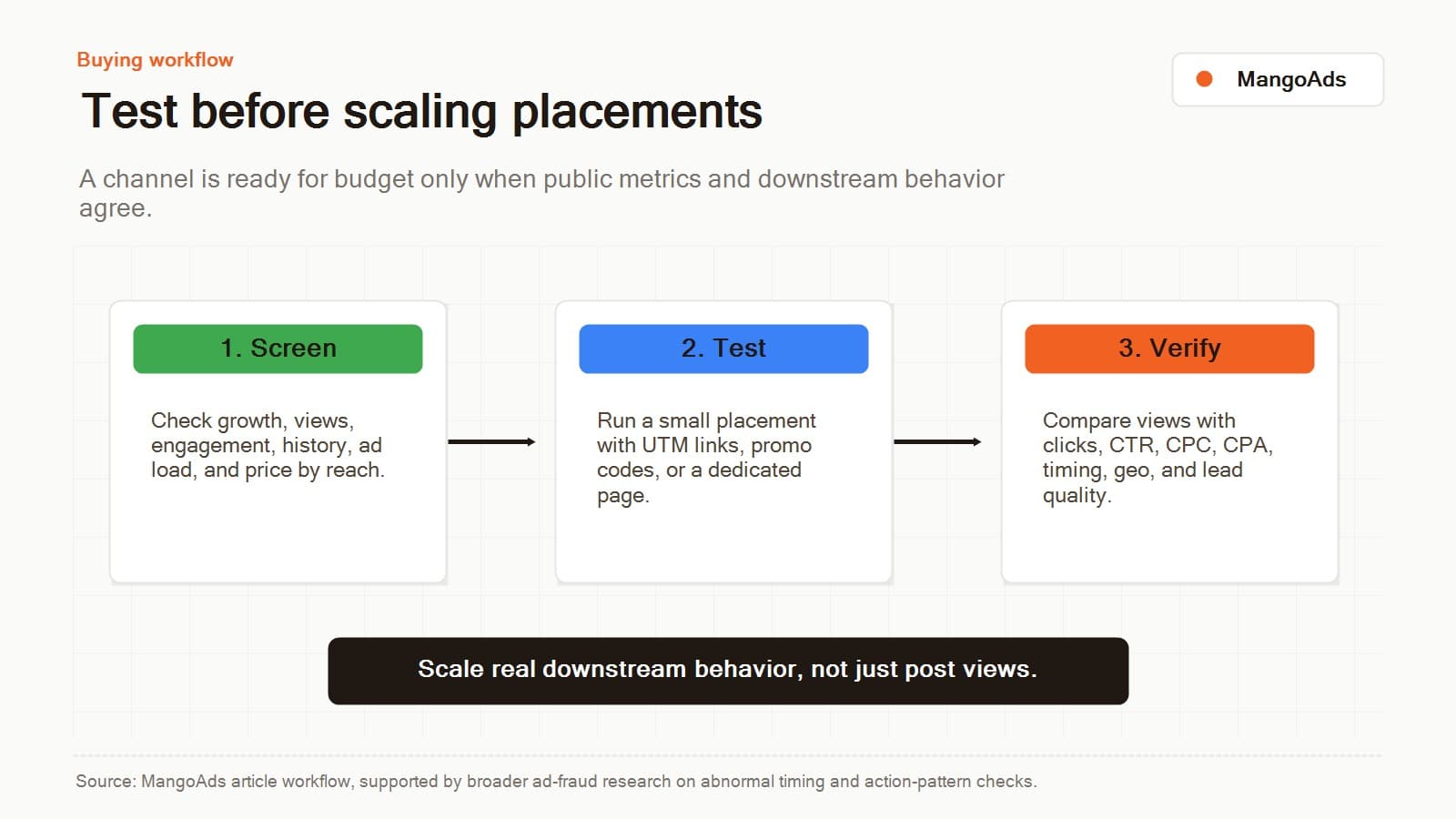
Even after a careful review, the cleanest proof is a small controlled test.
For a first placement:
- use one tracked link per channel when possible;
- add UTM parameters;
- send traffic to a dedicated landing page;
- use a unique promo code if relevant;
- track clicks, signups, purchases, bot starts, or other meaningful actions;
- compare results against expected CPM, CTR, CPC, and CPA.
Do not judge only by Telegram views. A fake or low-quality channel may deliver impressive view counts without meaningful downstream activity.
If the channel sends traffic, check traffic quality: bounce rate; time on page; conversion rate; signup quality; sales quality; repeated suspicious behavior from the same locations or devices.
The first test should answer one question: does this channel produce real audience behavior that matches your campaign goal?
Red Flags That Should Make You Reject a Channel
Reject the placement if several of these signals appear together:
- subscriber count is high, but recent views are extremely low;
- growth history shows unexplained jumps;
- views arrive instantly and mechanically;
- engagement is generic, repetitive, or unrelated;
- comments are full of spam or fake-looking praise;
- content topic changed recently;
- older posts are deleted or hidden;
- the channel publishes too many low-quality ads;
- the admin refuses basic questions about format, timing, or stats;
- pricing is based mainly on subscribers;
- the channel promises guaranteed sales or unrealistic results;
- test traffic produces views but no clicks or conversions.
The more warning signs you see, the less weight you should give to explanations from the seller. Strong channels usually do not need complicated excuses for their numbers.
What Manual Checks Can Miss
Manual checks are useful, but they are not perfect.
Some low-quality channels are obvious: strange growth spikes, weak reach, empty comments, repetitive reactions, and poor test results. Others are harder to judge. Aged bot accounts can look more natural than fresh bots. Temporary boosts can disappear before you review the channel. A channel may have real subscribers but still deliver low-quality traffic because the audience is passive, misaligned, or trained to ignore ads.
Manual checks also struggle with scale. If you are evaluating 3 channels, you can inspect each one carefully. If you are evaluating 50 or 100 channels, consistency becomes the problem. Different buyers may judge the same channel differently, and small warning signs can get missed when the campaign is moving fast.
That is why the safest workflow combines three layers:
- Pre-buy screening: reject obvious bad inventory.
- Controlled testing: start with small, trackable placements.
- Post-campaign analysis: scale only channels that produce real downstream behavior.
A Simple Decision Framework
Use this table when evaluating a Telegram channel:
| Situation | Decision |
|---|---|
| Metrics are consistent, audience fit is strong, and ad history is clean. | Approve for a small test. |
| Most metrics look healthy, but the price is high. | Negotiate or start with a smaller test budget. |
| Subscriber growth looks suspicious, but engagement appears genuine. | Investigate further before buying. |
| Views are strong, but clicks and conversions are missing. | Do not scale the campaign. |
| Subscriber count is high, but actual reach is weak. | Base pricing on views or reject the placement. |
| Comments, reactions, and views all appear artificial. | Reject the placement. |
| The channel contains scam-related ads or brand safety concerns. | Reject the placement. |
| The admin pressures you to buy quickly or refuses to provide performance statistics. | Reject the placement. |
Manual buying is not about finding perfect channels. It is about avoiding obvious bad inventory and testing the promising ones with enough tracking to make a real decision.
Manual Checks vs Automated Quality Control
Manual vetting works for a shortlist. It gets messy when the campaign scales.
If you are buying one or two placements, you can inspect each channel yourself. If you are planning a campaign across many Telegram channels, manual checks become slow and inconsistent. You have to compare channels, negotiate with admins, check stats, track links, monitor placements, and decide which channels deserve more budget.
This is where automation earns its keep.
MangoAds is built to reduce the manual work of buying Telegram ads. Instead of asking advertisers to find and inspect every channel one by one, MangoAds applies quality control and anti-fraud checks before channels are connected to the platform. Low-quality Telegram channels are filtered out instead of being offered to advertisers as inventory.
Advertisers should still track performance, compare CPM and downstream metrics, test creatives, and optimize placements. The difference is that you are not starting from a random list of channels where every placement needs a full fraud investigation.
For direct buys, use the checklist in this article. For scalable campaigns, use a platform that already treats channel quality as part of the buying process.
How to Evaluate Results after the Placement
Fraud checks do not end when the ad goes live.
After the placement, compare:
- promised or expected views vs actual views;
- click volume vs view volume;
- CTR by channel;
- CPC and CPA;
- conversion quality;
- landing page behavior;
- timing of clicks;
- user quality in your CRM, bot, app, or analytics platform.
- Watch for post-campaign warning signs:
- high views and almost no clicks;
- clicks that arrive in unnatural bursts;
- traffic from irrelevant countries or languages;
- many bot starts but no real conversation or activation;
- signups with low-quality or repeated data;
- conversions that do not progress beyond the first step.
Sometimes a channel is not fake. It is just wrong for your offer. Keep those conclusions separate: fraud risk, audience fit, creative quality, and landing page performance are different problems.
Here is a simple way to read post-campaign data:
| Result | Likely interpretation | Next step |
|---|---|---|
| Good views, good clicks, and good conversions | Strong alignment between the channel, audience, and offer. | Scale the campaign carefully. |
| Good views, good clicks, but weak conversions | The audience may be interested but not well qualified, or the landing page may need improvement. | Review the offer and optimize the landing page. |
| Good views but almost no clicks | The creative, CTA, or traffic quality is likely the issue. | Run one more test only if other performance signals remain strong. |
| Low views compared with the expected reach | The placement underperformed, the channel's actual reach is weaker than expected, or pre-purchase metrics were inflated. | Do not scale the campaign. |
| Clicks arrive in unnatural bursts | Possible low-quality or artificial traffic. | Investigate before purchasing another placement. |
| Many bot starts but almost no activation | The bot onboarding flow may be weak, or the traffic quality is low. | Segment the traffic and analyze user behavior. |
Final Checklist before Buying Telegram Ads
Before you pay for a placement, answer these questions:
- Does subscriber growth look natural?
- Do recent post views match the channel size?
- Are views consistent without looking mechanical?
- Do reactions and comments look human?
- Has the channel kept a consistent topic and audience?
- Is the ad history clean and relevant?
- Is pricing based on real reach, not only subscribers?
- Did the admin provide clear placement terms?
- Can you track clicks and conversions?
- Are you starting with a test before scaling?
If several answers are weak, skip the placement. There are always more channels to test, and avoiding bad inventory is often the fastest way to improve Telegram ad performance.
Bottom Line
Fake Telegram channels are not only a fraud problem. They are a media buying problem.
The safest advertisers do not buy based on subscriber count alone. They check growth, reach, engagement, comments, content history, ad history, pricing, and test results. They separate fake traffic from poor audience fit. And they scale only after a channel proves it can create real user behavior.
If you buy placements manually, use this checklist before every deal. If you want to run Telegram ads across multiple channels without inspecting each placement from scratch, MangoAds can help by filtering low-quality channels before they become available in the platform.